


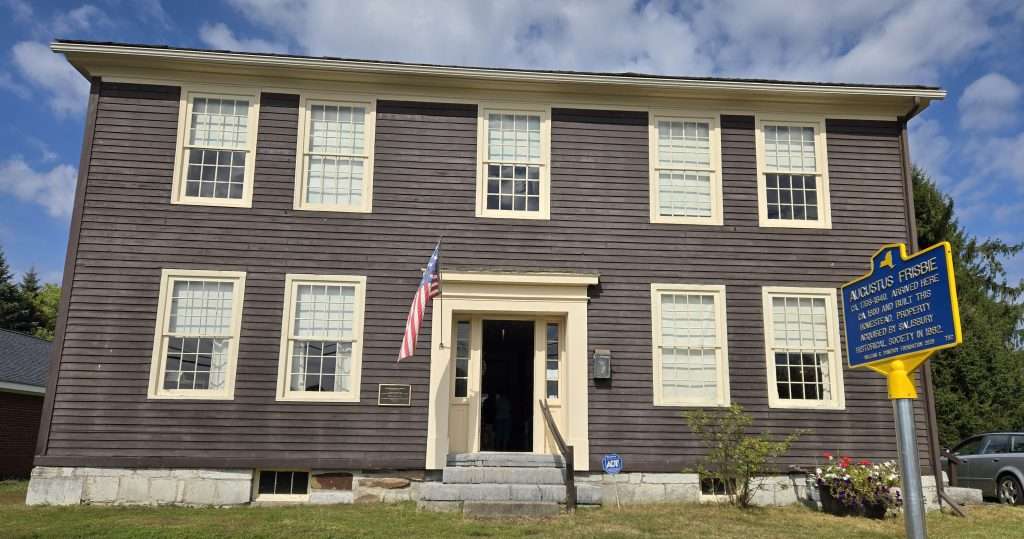
Augustus Frisbie House, Home of the Salisbury Historical Society.
Story and photos by Carol Vogel
On Sunday, September 22, the Salisbury Historical Society held a dedication ceremony at the Frisbie House. After many years, a historical roadside marker was unveiled to celebrate this important local home.
Nora Cool-Guinup, president of the Historical Society, led the dedication. She spoke of the home’s history, the great restoration project, and the dedication of the volunteers and members as they continue to care for the Frisbie House.

Nora Cool-Guinup stands to the right of Elaine Carlin after the unveiling of the historical marker.
“We, the members of the Salisbury Historical Society, dedicate this sign to those who volunteered their time to restore and preserve this house for future generations. We applaud those volunteers who are still with us today and those who have passed and thank them for all their dedicated work. We have this beautiful home for the Historical Society to showcase our history and educate about the past.” Before unveiling the marker, Nora also introduced a special guest, “We have Mrs. Carlin here today, if you do not know, she was the project Manager of the restoration project!”
The unveiling was a proud moment for all involved and attending, especially for former Society President, Elaine Carlin.
The Frisbie House
The Frisbie House is a Federal-style home built in 1805 – 1806 by Bilious Avery for Augustus Frisbie. Inhabited as a single-family dwelling and including land used for farming, the home had many owners. After 1914 the Tanner family turned the home into a two-family apartment house.
According to the Salisbury Historical Society, “In 1981, the Salisbury Historical Society took title to the property because it is the oldest frame building still standing in Salisbury and to provide a home for the society and its collectors.”
The Society hosts a special installation each year along with its regular collection of local artifacts, furniture, art and lifestyle. This year’s installation is honoring Local Military Veterans and will be on display until November 2024.
Restoration Project:
There was a large amount of work to do to restore the Frisbie back to its original configuration. Volunteers, with the leadership of Elaine Carlin, worked to take out partitions, two kitchens and bathrooms as well as a second set of stairs. Research was an important part of the restoration process to determine the original layout of the home. Information was found to help construct chair railings, walls and flooring. Wallpaper and original paint colors were noted as the walls were stripped and repaired.

Before and After Restoration of the Frisbie House, courtesy of Salisbury Historical Society
With over 50 volunteers working on the restoration for over 8 years, it was no small feat. Work included foundation wall re-pointing, replacing cedar clapboards on 3 sides of the house, 19 window restorations, a new roof, insulation and central heating installation. Local craftsman and technical professionals aided in this endeavor creating a community wide restoration project.
“Not only were there people who did the physical work on the house but there were many people behind the scenes looking for grants and fundraising as it cost thousands of dollars to do this project,” explained Nora. Nora mentioned that during the project, Elaine kept a journal for the Society detailing the work that was done each day. She also took many photos as the work progressed. Serving as a record of how the restoration was done step by step, these are great resources for the society moving forward. Nora added, “Over 12,000 hours went into this restoration project!”
On display were images of the project from beginning to end showing the incredible amount of work it took to restore the home.

Images from the Society’s display. The Restoration Process was meticulously documented by Elaine Carlin. Photos courtesy of Salisbury Historical Society.
Historic Marker
The Historical Society applied to the Pomeroy Foundation for the sign. It took some time after the sign was delivered before it could be installed at the Frisbie House. Nora said that while the sign had been approved, completed, and delivered in 2020, with Covid and other delays, they were only now able to place it and hold the dedication ceremony.
The William G Pomeroy Foundation provides grant assistance for historical marker signage. According to their website, “Our grants are open to 501(c)(3) organizations, nonprofit academic institutions and local, state and federal government entities.”

Nora Cool-Guinup addresses the crowd at the historical marker dedication ceremony.
“The William G. Pomeroy Foundation is committed to supporting the celebration of the preservation of community history and working to improve the probability of finding appropriate donor matches or other life-saving treatments for blood and cancer patients. Established by Trustee Bill Pomeroy in 2005 to bring together his two greatest passions, The Pomeroy Foundation is a private philanthropic organization located in Syracuse, NY. As the nation’s leading funder of historical roadside markers, the Pomeroy Foundation has awarded more than 2,400 grants for markers and bronze plaques in 48 states and Washington, D.C. To learn more about the Pomeroy Foundation, visit www.wgpfoundation.org.”
Commemorating History

The Frisbie House is located at 109 Route 29A in Salisbury Center, NY. It is open Sunday from 1 to 4 p.m., weekly from June to November. Please call 315-429-8030 to make an appointment or schedule a group tour. For more information, visit the Salisbury Historical Society on Facebook at https://www.facebook.com/SalisburyHistoricalSociety/.