
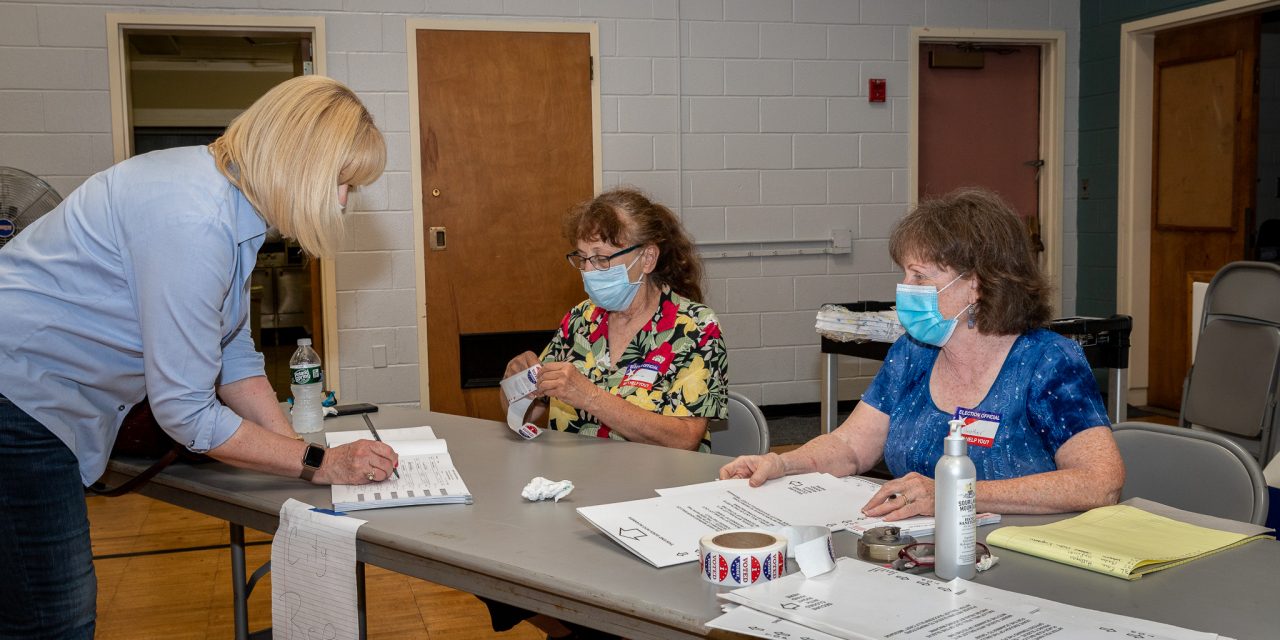
The polls open this morning at 6 am and will remain open until 9 pm at the Holy Family Parish gymnasium. Voters in the City of Little Falls will be asked to decide the fate of five ballot measures, and who should be the next State Supreme Court Justice from the 5th Judicial District, County & Surrogate Court Judge, County Legislator for Herkimer County, City Clerk for the City of Little Falls, City Treasurer, and Alderman for the City.
Each Ward has two representatives that you can vote for, except for Ward 3, which has incumbents Brian Marhaver and Mark Ruffing facing Voice of the People candidate Caroline Bridgeman.
For City Treasurer, Anthony T. Federico is running unopposed to fill the vacant position.
Dave Petkovsek had previously held the job for 30 years and announced his retirement in May of 2020. Robert Peters Jr. was appointed to succeed him starting at the beginning of this year but would have had to run in the November election.
When Peters left the job, Kathy Prestopnik took a leave of absence from her position as senior account clerk and was then appointed as acting City Treasurer.
Summary of Statewide Ballot Proposals
Here is a summary of the Statewide Ballot Proposals. The full text of each can be found here: https://www.elections.ny.gov/2021BallotProposals.html
Ballot Proposal 1: Amending the Apportionment and Redistricting Process
The purpose of this proposal is to amend the portions of Article III of the New York Constitution that relate to the way district lines for congressional and state legislative offices are determined. The proposal would do the following:
- Amend and repeal portions of the state constitutional amendment adopted by voters in 2014 that created a redistricting commission.
- Allow the redistricting commission to appoint two co-executive directors by simple majority vote, without consideration as to the party affiliation of the individual being appointed. Furthermore, this amendment would eliminate the alternative process currently in place that allows for the appointment of co-executive directors and co-deputy executive directors by the legislature should the redistricting commission fail to appoint co-executive directors, and remove the requirement that the two co-executive directors of the redistricting commission be members of different political parties.
- Freeze the number of state senators at the current number of 63. Currently, under the state constitution, the number of senators was originally set at 50 and thereafter increased over time to 63.
- Require that state assembly and senate district lines be based on the total population of the state, and require the state to count all residents, including non-citizens and Native Americans if the federal census fails to include them.
- Provide for incarcerated people to be counted at their place of last residence, instead of at their place of incarceration, for the purpose of redistricting. This practice is already established by state statute for Senate and Assembly districts.
- Revise the procedure for drawing and approving Congressional and state legislative districts scheduled to be first applied in 2022. The proposed amendment would alter the redistricting procedure in the following ways:
- Change the redistricting map approval procedures for the redistricting commission and legislature by making changes to the voting thresholds needed to approve/adopt a plan. Under this proposal:
- Approval of a plan by the redistricting commission would require at least seven votes, out of the ten commissioners, in favor thereof. There would no longer be a requirement that at least one commissioner appointed by each of the legislative leaders vote in favor of a plan in order to approve it. A plan approved by at least seven commissioners must be approved by a majority of each house of the legislature to be approved.
- However, in the event that the redistricting commission votes on but does not have the seven votes needed to approve a plan, the commission is required to send the legislature the redistricting plan or plans that garnered the most votes. The legislature would be able to adopt such plan with a 60% majority. This amendment would repeal the requirement that in the event the speaker of the assembly and the temporary president of the senate are members of the same political party, approval shall require the vote in support of it’s passage by at least two thirds of the members elected in each house. If the commission fails to vote on any plan or plans by the deadline, all plans, including draft plans in the commission’s possession are sent to the legislature, and each house of the legislature can introduce and adopt such a plan with or without amendments.
- The redistricting commission voting requirements and legislative vote thresholds for approving the commission’s plan would no longer vary depending on the political affiliation of the Temporary President of the Senate and the Speaker of the Assembly.
- Require the redistricting commission that draws the lines to submit its redistricting plan and implementing legislation to the Legislature two months earlier than called for under the current procedure the timeline set forth in the 2014 state constitutional amendment. (For the redistricting cycle due to proceed in 2022, the time frame would be condensed to meet election-related deadlines).
- Remove certain restrictions on how Senate district lines are drawn, including the “block on border” rule that require placing of blocks on the border of districts in certain districts.
- Delete certain provisions that the United States Supreme Court has deemed unconstitutional.
Ballot Proposal 2: Right to Clean Air, Clean Water, and a Healthful Environment
The proposed amendment to Article I of the New York Constitution would establish the right of each person to clean air and water and a healthful environment. Shall the proposed amendment be approved?
The purpose of this proposal is to protect public health and the environment by adding the right of each person to clean air and water and a healthful environment to the Bill of Rights in Article I of the New York Constitution.
Ballot Proposal 3: Eliminating Ten-Day-Advance Voter Registration Requirement
The proposed amendment would delete the current requirement in Article II, § 5 that a citizen be registered to vote at least ten days before an election and would allow the Legislature to enact laws permitting a citizen to register to vote less than ten days before the election. Shall the proposed amendment be approved?
Section 5 of Article II of the New York Constitution now requires that a citizen be registered to vote at least ten days before an election. The proposed amendment would delete that requirement. If this amendment is adopted, the Legislature will be authorized to enact laws permitting a citizen to register to vote less than ten days before the election.
Ballot Proposal 4: Authorizing No-Excuse Absentee Ballot Voting
The proposed amendment would delete from the current provision on absentee ballots the requirement that an absentee voter must be unable to appear at the polls by reason of absence from the county or illness or physical disability. Shall the proposed amendment be approved?
The purpose of this proposal is to eliminate the requirement that a voter provide a reason for voting by absentee ballot. The proposed amendment would do so by deleting the requirement currently in the Constitution that restricts absentee voting to people under one of two specific circumstances: (1) those who expect to be absent from the county of their residence, or from New York City for residents of that city, on Election Day, and (2) those who are unable to appear at their polling place because of illness or physical disability.
Ballot Proposal 5: Increasing the Jurisdiction of the New York City Civil Court
The proposed amendment would increase the New York City Civil Court’s jurisdiction by allowing it to hear and decide claims for up to $50,000 instead of the current jurisdictional limit of $25,000. Shall the proposed amendment be approved?
The purpose of this proposal is to amend Article VI, Section 15 of the New York Constitution to increase the jurisdiction of the New York City Civil Court. The New York City Civil Court is currently limited to hearing and deciding claims for $25,000 or less. The proposed amendment would allow the New York City Civil Court to hear and decide claims for $50,000 or less.