


Chief Swartz and the members of the fire department pause for a picture with Police Chief Reardon, members of the Police and Fire Board, as well as members of the Common Council. The picture was taken shortly after Swartz was appointed Fire Chief in 1947, he is seated in the bottom row, third from the left. All photos are courtesy of the Little Falls Historical Society.
On March 1, 1947, the Little Falls Fire Department had a new chief Abram (Abe) Swartz, who succeeded his long-time mentor and colleague, Chief Edward Cooney.
Swartz was born in 1897 in the Town of Danube. Before joining the LFFD in January of 1923, he had served in the United States Navy during World War I. On August 4, 1928, he married the former Fannie Austin with whom he had one daughter. Abe Swartz had big shoes to fill in replacing Chief Cooney, but he was certainly up to the task.
Much like when Edward Cooney became the head of the department, Chief Swartz was facing dramatic changes within his department and outside of Little Falls. World War II had just ended, leaving the United States and the Soviet Union as the world’s two undisputed “superpowers”. Five weeks after Swartz became Chief, Jackie Robinson made his Major League Baseball debut breaking a color barrier that had been in place since 1876. The “Baby Boom” had begun, and soon a new phenomenon called the suburbs would spring up all over the country altering the landscape of the United States even further.
At home, the Little Falls Fire Department would undergo major changes as well. Shortly after Chief Cooney retired, the Common Council and Police and Fire Board decided the fire department needed to be evaluated. Why this was done is unclear, as there was no indication that either entity was dissatisfied with the job that Chief Cooney had done. With 24 years of experience as a firefighter (five of them as Assistant Chief), Abe Swartz was capable of running the department on his own.
For whatever reason, Joseph Sullivan was hired to do a complete evaluation of the fire department and went to work as soon as Chief Swartz took over. Sullivan had recently retired as Public Safety Commissioner for the City of Utica. If Chief Swartz was upset by this he never showed it. He completely cooperated with Commissioner Sullivan to get the job done.

This picture was taken in May of 1947. On the far left is Commissioner Joseph Sullivan, and in the 1942 Mack to his immediate left is Clarence Smith. Standing between the two trucks is Fire Chief Abram Swartz, and at the wheel of the 1917 Mack with the department dog “Tippy” is George Miller. Lastly, standing in front of the 1917 Mack is former chief Edward Cooney.
By May of 1947, Commissioner Sullivan’s evaluation was complete. While he did not find any glaring deficiencies, Sullivan did recommend some changes. For instance, he suggested a kitchen be built in the fire station. Prior to the kitchen, each firefighter went home for an hour for each meal – a necessity considering until 1942 they worked six 24-hour shifts per week. With fewer shifts worked thanks to the new platoon system and a new kitchen, the firefighters would no longer need to go home for their meals.
Commissioner Sullivan also apparently felt the firefighters should be more comfortable in the station, as he recommended new beds and chairs be purchased. The Police and Fire Board agreed, and in the spring of 1947, Feldman’s Furniture in Little Falls furnished the station with new beds and chairs.

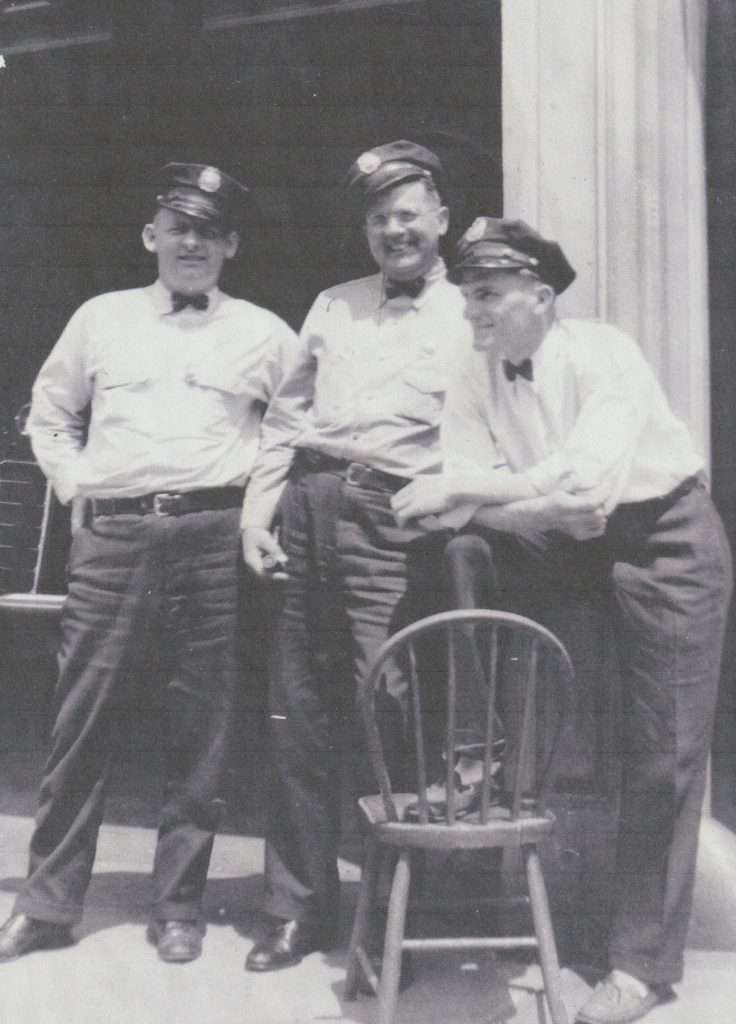
Another one of Commissioner Sullivan’s recommendations that is still in effect today is that the on-duty firefighters wear uniforms. Shown here from the left are Clarence Smith, George Miller, and Stephen Talaba. The picture was taken in the late 1940’s
The last big suggestion Commissioner Sullivan made was the re-organization of the call firefighters. Beginning in the 1930’s right up until the time of Sullivan’s survey, the call firefighters were called “volunteers.” Instead of being paid a flat semi-annual rate as they had been, the volunteers were paid by the alarm – and the pay was minimal. This could have been started as a cost-saving measure to help the city battle the effects of the Great Depression, but it would ultimately cost Little Falls dearly.
In 1939, The New York State Fire Insurance Rating Organization dropped Little Falls from a Class A to a Class B fire insurance rating. The reason given is that the LFFD used volunteers and was therefore not a completely professional department. Commissioner Sullivan urged the city to re-organize the volunteers back into a call force that was appointed city employees. The city government followed through with the recommendation.
The members of the re-organized call force were as follows: Charles Van Slyke, James Bullard, Claude Adams, Howard Christman, Bernard Crimmins, Gus Goldstein, George Harwick, John Harwick, William Higgins, Herbert Jones, William Malone, Jr., Claude Miller, Charles Phillips, Sr., Thomas Rathbun, Peter Rieman, Jr., Albert Silvernail, Harvey Spencer, Ray Taylor, Floyd Weller, and Leonard Young. Sullivan also suggested the call force be increased to 26 firefighters and four bunkermen. This would eventually be done, and the new call force would train every Tuesday night.
Early Tests for the Re-Vamped Department
The first big test for the re-vamped department would come early in the morning of January 26, 1948. The Richmond Apartment Building at 314 South Mary Street (the street no longer exists) had a major fire caused by a defective boiler that threatened the lives of its occupants.
First on the scene for the LFFD was Chief Swartz, along with firefighters Bert McGowan, George Miller, and Stephen Talaba, and they were assisted by Little Falls Police Officer Frank Wnuk. The department rescued 16 people through the smoke-filled hallways and down ladders from the second and third floors. Among the rescued were children and a blind woman who was brought down a ladder from the second floor by firefighter McGowan. Although six families were displaced and the building was badly damaged, everyone made it out and no one was injured.
For many years, Little Falls Hospital had a nurse’s home. The nurse’s home provided a place for the nurses to stay, but on September 9, 1949, it was the site of a horrible tragedy – as a 35-year-old nurse named Margaret Quinn was fatally burned in her room.
Quinn, who had been in a depression since the death of her husband, was found by another nurse named Margaret Richardson engulfed in flames in a wicker chair. Richardson went to get a towel to try to smother the flames, but when she returned the entire room was on fire.
When the fire department arrived, they found the door jammed shut so a second crew raised a ladder to the window and began extinguishing the flames from there. In the meantime, the crew at the door had made entry and were able to finish fighting the fire.
The work of the firefighters had kept the blaze contained to that room, but it was too late for Mrs. Quinn. An examination revealed her clothes had an accelerant on them that was most likely a detergent and the fire itself was caused by a dropped cigarette. Strange circumstances with a tragic ending.


This group photo was taken on August 29, 1948, at the fire station. Front row (left to right): Ben Amell, Charles “Happ” Steele, Bob Singer, Roswell Brown (with Tippy in the wheelchair), Hugo Goering, Ira Hoke, Stephen Talaba, and Bernard Crimmins. Middle row (left to right): Charles Phillips, Thomas Keneally, Dave Clark, Chief Cooney, Charles Van Slyke, Chief Swartz, Harvey Spencer, Bert McGowan, and John Harwick. Back row (left to right): Leonard Young, Assistant Chief Clarence Smith, Bill Malone, Claude Miller, Bert Rockefeller, John Nichols, Pete Rieman, Charles Phillips, Jr., George Miller, James Bullard, William Higgins, Floyd Weller, and Paul Swancara.