

Story and Photographs By Joan Herrmann
Whereiwander…. Especially on a cold, clear, crisp night it might be outside to our balcony. On a clear moonlit night, I am sometimes surprised to hear a number of interesting sounds, too. I have heard a Great Horned Owl on a few occasions as well as Barred Owls communicating with one another. It is always exciting to hear a coyote or a few communicating also. Over the years, the DEC has reported that coyotes are an integral part of our ecosystem and can provide many benefits through observation, photography, hunting, and trapping. Coyotes are seldom seen and definitely avoid contact with humans which are their main predators. Thirty-eight thousand is about the estimated population of coyotes in New York State.
I have had numerous sightings of coyotes over the past thirty years that we have been living in the Adirondacks and I imagine that you may have too. However, a sighting always manages to surprise and delight me. Coyotes are members of the Order Carnivore and the family of Dog, its Genus and species name is Canis latrans meaning “barking dog”. They have a trim build, pointed ears, and a muzzle, and their coat is a yellowish gray. Their throats are a buff color, and so are their underparts. Like German Shepherd dogs, they have coarse, heavy coats, and the outer hairs are tipped with black. Their bushy tails have a black patch on top; this patch is the location of the tail scent gland. Both males and females have the same coloring and markings. The male coyote is generally larger than the female, weighing eighteen to forty pounds. Female coyotes weigh between fifteen and forty pounds. Their body length is three and one-half feet to four feet, and their tails are about twenty-six inches. It may be difficult to distinguish a coyote from a wolf or a domestic dog. However, an identifying clue could be that a coyote always carries its tail downward when running or walking, while a wolf carries its tail horizontally.
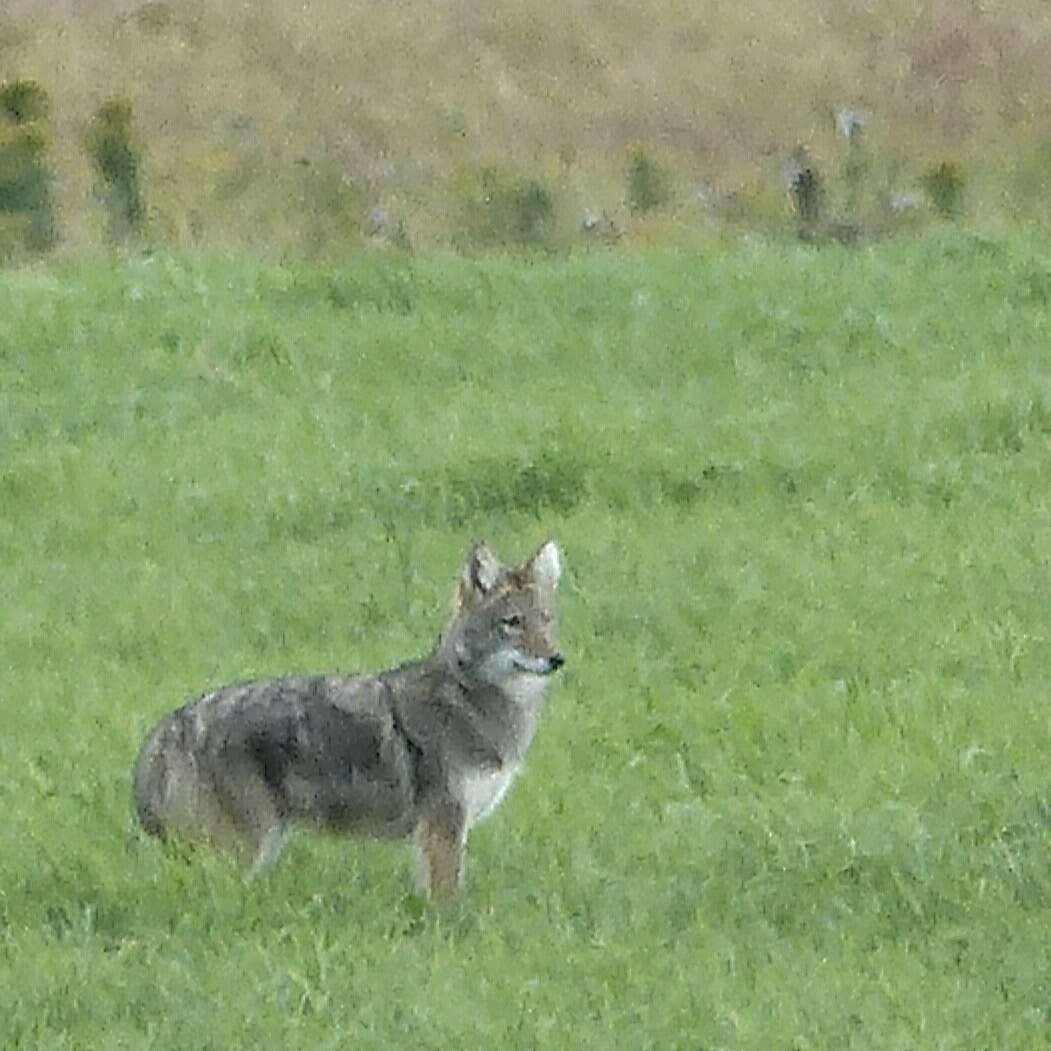
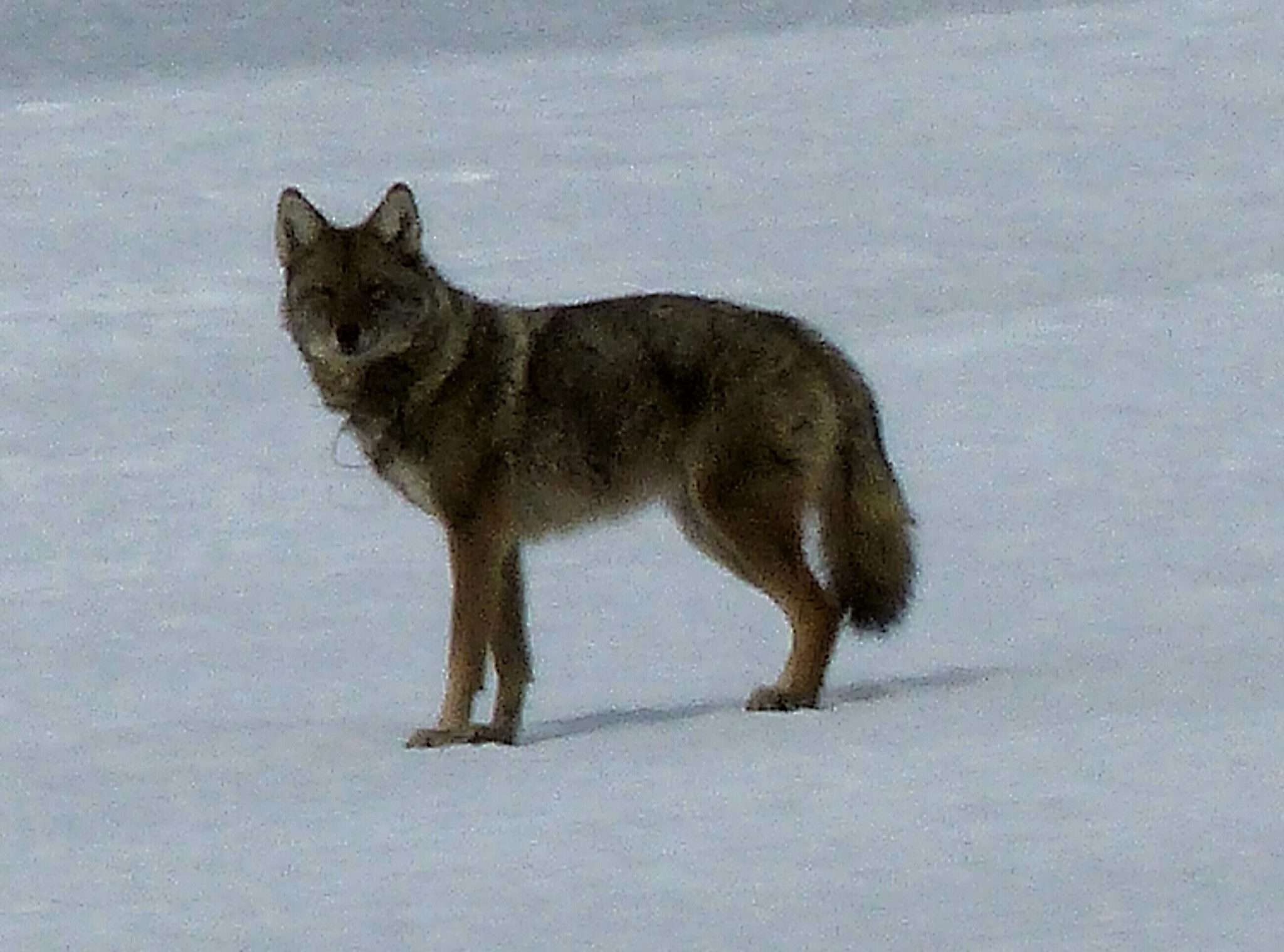
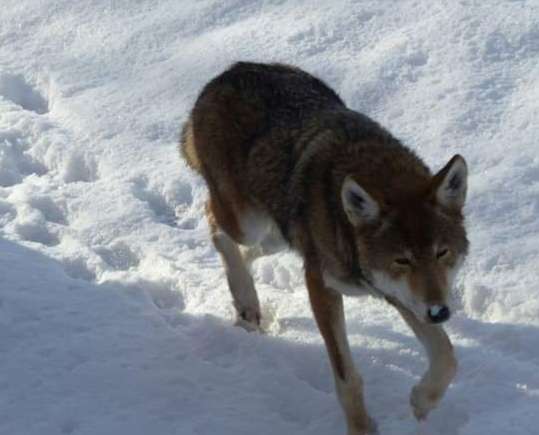
Coyotes are known to live in “families” rather than packs, having a flexible social organization. The family may consist of a mated pair and offspring of various ages. They travel, sleep, and eat together with a dominant male. They generally have well-defined territories of about eight to ten square miles and will defend it from other coyotes by marking their territory boundaries with urine and feces. Families are more common in winter, particularly when tracking and taking down large prey, such as white-tailed deer. Lone hunters are more common in summer when prey becomes smaller mammals. Although basically carnivores have diets that include rodents, amphibians, reptiles, rabbits, hares, and groundhogs, they occasionally eat berries, pears, apples, and grass. When hunting, coyotes use olfactory (smelling), auditory (hearing), and visual (seeing) means to find their prey, and unlike wolves, they approach and attack the prey from the front. They generally cache leftover food by burying it.
Mating begins in January and continues through April. The female comes into estrus for only a short time (four to fifteen days) once a year. The gestation time is about sixty days, and the litter is typically five to seven pups, depending on the availability of food. The pair can dig a den, but quite often they make use of a den that was dug by a groundhog. The female and the pups will spend several weeks using the den and then will abandon it once the pups separate. For the rest of the year, all the coyotes will sleep on the ground near the shelter of a tree or log. In harsh weather, they will wrap their tails around their body for extra warmth.
Before the pups are born, the male will bring food to the female. The female nurses the pups for three to four weeks. When the pup’s teeth begin to emerge both the male and female will regurgitate food for the pups to eat. Occasionally another female of the family will help with the raising of the pups. Around six weeks, the pups will begin to sleep outside of the den. During the day, they begin to become aggressive with each other, establishing a dominance of order. By three months old, they will begin hunting with their parents. At five months, they are hunting on their own, and within six to nine months, they start to disperse or may stay with the family for the winter.
Vocalization, facial expression, and scent marking are three distinct ways that coyotes communicate. Coyotes emit many different vocalizations among them: growls, woofs, barks, howls, and yelps. The sounds may be used to provoke, to alarm, or to greet. Woofs and growls are used at short distances as threats or alarms, and one or the other may alert the pups to retreat back into the den. At longer distances, barks or howls have the same meanings as woofs or growls. A yelp is usually a sign of submission. A lone howl may be given if a member has become separated from the family. The “wow oo wow” sound is a “greeting sound.” Facial expression and posturing can range from submissive to extremely aggressive. Submissiveness may be exhibited with the head held high, neck arched with shoulder and neck hairs erect. Aggressiveness is exhibited when the head is held high, the neck is arched with shoulders and neck hairs erect, the eyes are narrowed, and the mouth is open, exposing the canine teeth. Scent marking is probably the most effective way canines communicate. Domestic dogs may be seen leaving “pmail” on every outing. Coyotes have two anal glands and a scent gland on the top of their tail. Scent can impart identification of individuals, territorial boundaries, and mating status.
Perhaps you have seen a domestic dog, fox or even birds showing an abundant loss of hair of feathers, many times the cause can be attributed to a parasitic mite. Mange, both Sarcoptic and Demodectic, can also be found in coyotes, in addition to rabies and canine distemper. Hopefully, this information will discourage you from feeding or enticing canine wildlife onto your property. They are truly beautiful animals, and, like the slogan reminds us, “a fed wild animal becomes a dead wild animal”. Respect them, admire them in their habitat, photograph them, and allow them to remain wild…

In 2007, she began working with the Black River Outdoor Educational Program (BROEP). In 2013 and 2014, she did a week-long summer program at BROEP with Mohawk Valley Community College (MVCC).
Using her love of nature and photography, she created a Flora/Fauna outdoor educational program teaching students (ages 6 to 14) the joys of nature and creative photography skills.
Joan’s love of nature has been a lifelong study of Birds, Wildflowers, Mosses, Ferns, Trees, Amphibians, Reptiles, Grasses, Insects, Spiders, Tracks, Scat, and Galls. She has assisted in cataloging all trails used by the hiking Coaches and photographed and identified seasonal Flora.
Since October 2016, she has written a bi-monthly nature column with Adirondack Express Newspaper. In October 2019, she began a bi-monthly column with the My Little Falls newspaper. You may reach her at jmhphoto8442@gmail.com.