


Story and Photographs By Joan Herrmann
Whereiwander… consulting the internet, the first day of Spring will be on Thursday, March 20, at 5:01 AM EDT. This is when the spring equinox, the day and night, are just about equal in length. However, when I look out our windows and have had almost 30 years of living up here in the Adirondacks, Spring weather may not necessarily appear for many more weeks. In addition to being able to see delightful spring flowers and returning migratory birds, such as the first Robins, I always look for the first butterflies of the spring season, too. The monarch butterflies won’t begin their journey from wintering in Mexico and will not reach our area until June or July. But, we may have an opportunity to see some of the butterflies which have overwintered here.
Several butterflies winter over as adults. They go through a type of “hibernation,” which is called “diapause.” In late autumn, they will produce a type of natural antifreeze, also known as glycogens, into their body fluids, which will prevent the creation of ice crystals within their cells. The physical changes in their body begin as our daylight decreases. They will begin to seek out appropriate wintering over possibilities such as crevices in trees, logs, or even cracks in buildings. The diapause state allows them to survive extremely cold weather well into the minus degrees. There are three species that I have seen very early each spring they are the Mourning Cloak, the Eastern Comma and the Question Mark.
The Mourning Cloak (Nymphalis antiopa) is a dark brown butterfly with an inside border of blue and an outside margin of creamy yellow. They are quite often found on the road in a sunny spot or near the edge of a stream. You may even find numerous males together “puddling.” You may see one or many butterflies using their proboscis (a tongue-like sipping tube) to suck up minerals, nectar, or sap. It is referred to as puddling. You might even see numerous butterflies puddling on animal scat doing the same thing in which they are retrieving minerals.

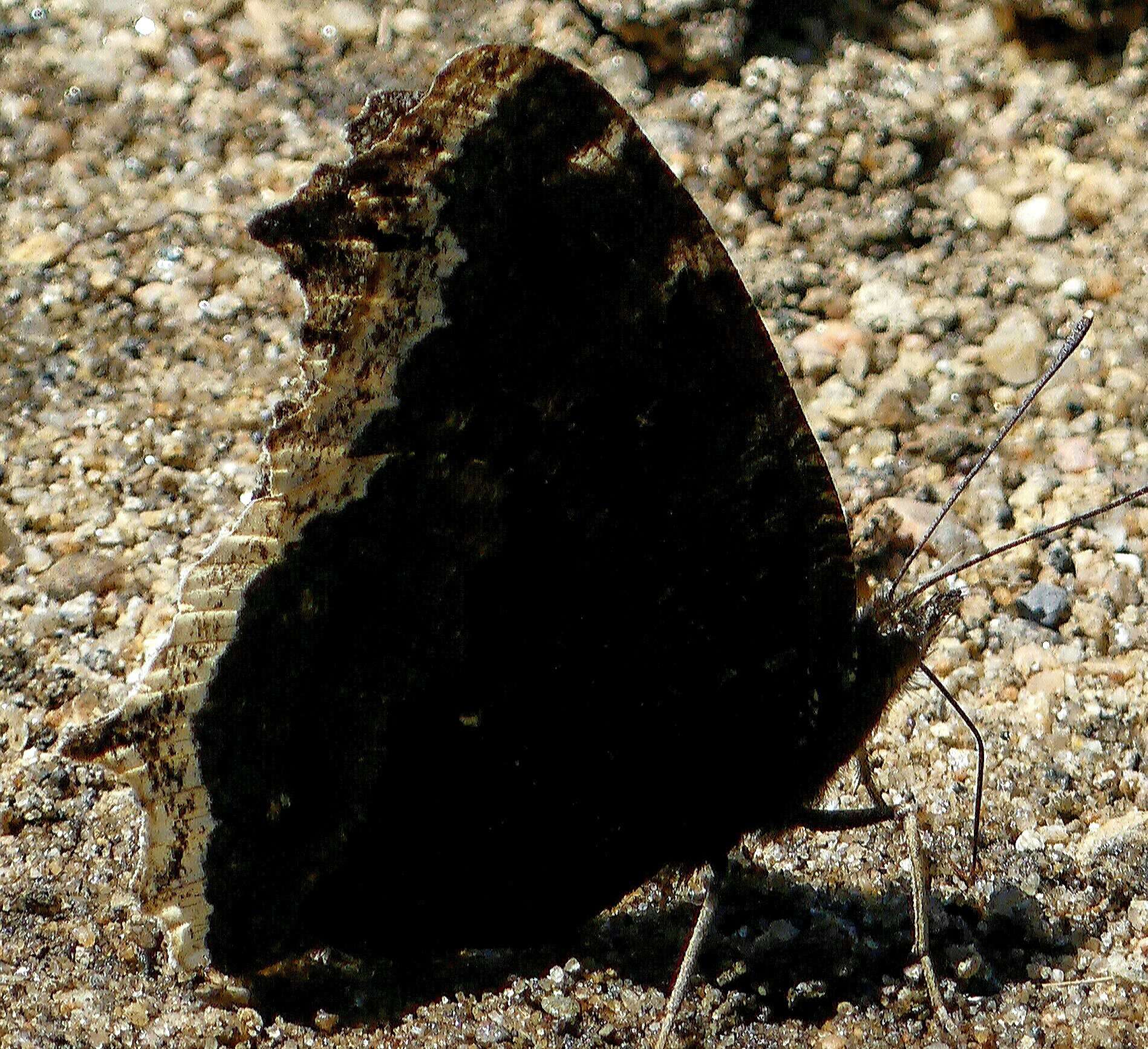
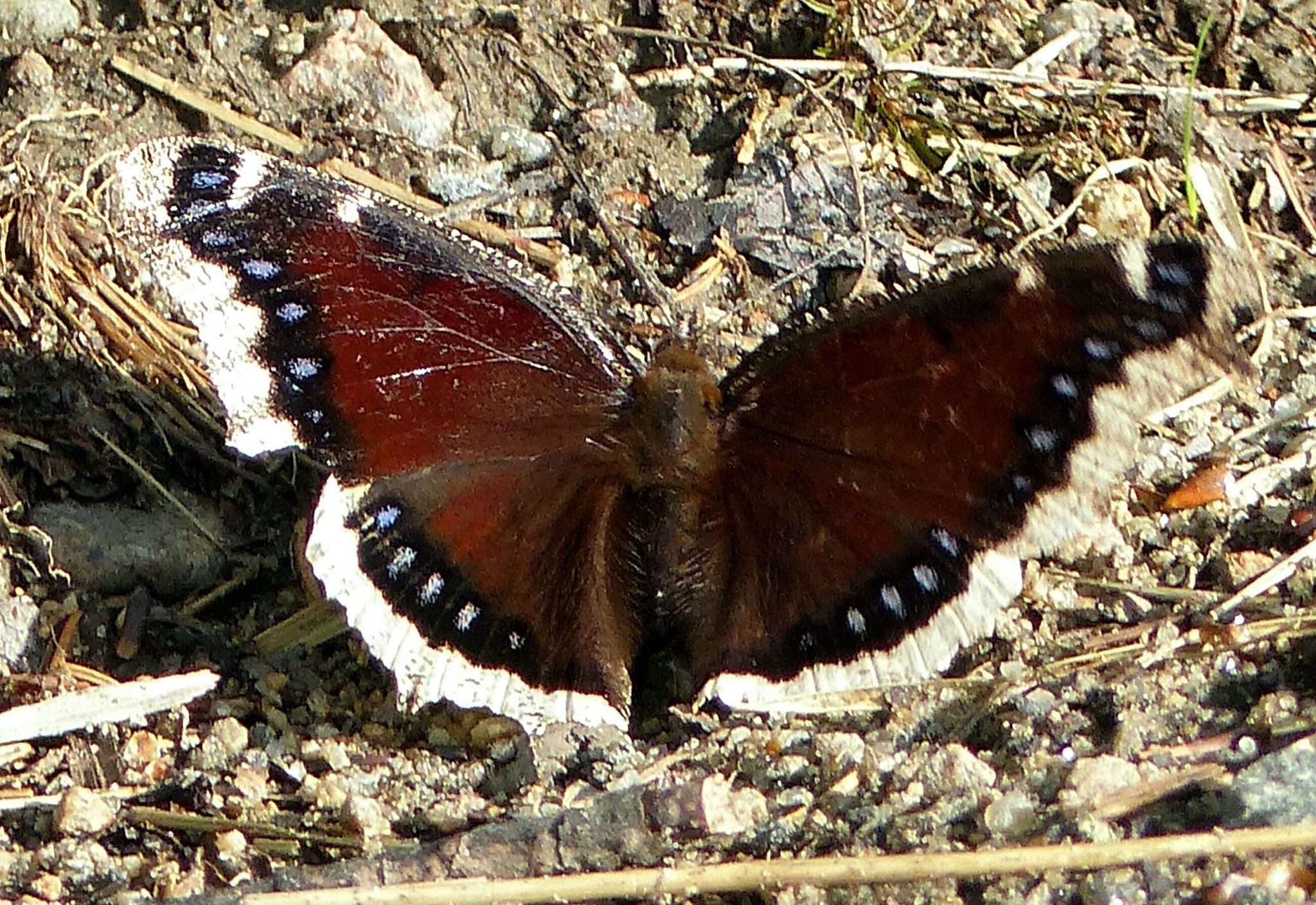
The Eastern Comma (Polygonia comma) and the similar in appearance Question Mark (Polygonia interrogationis), and with their wings closed, they can easily camouflage themselves on the bark of most trees. The question mark butterfly has a white curve with a white dot beneath, which resembles a question mark symbol, and the comma butterfly only has the curve but no white dot. Many other butterflies will begin emerging as the temperatures rise. They will have wintered over as pupa or chrysalis, and some may have even wintered over as eggs.
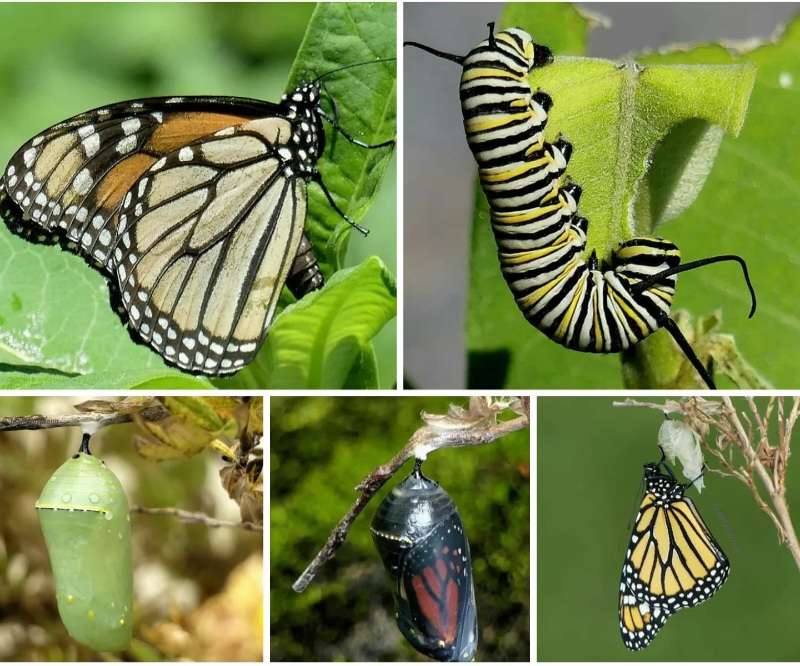
The life cycle of a butterfly begins when the adult butterfly lays her egg on its host plant. The transformation from egg to larva, pupa and adult is thought to be a miracle, I totally agree. The female selecting the correct host plant is critical. The hatching larva (caterpillar) is a minuscule “eating machine,” and it will consume the plant and other host plants until it has gone through at least five growth stages, which are known as “instars.” Each stage of instar the larva will shed its outgrown skin and continue to eat until the next stage which is the pupa or chrysalis stage, unlike moth larvae, which spin a cocoon. The butterfly larva spins a “silk button” to a piece of plant material and hangs until the its last instar skin is shed. Then, the larva begins to harden into a shape specific to its species (for example, a “jellybean” shape for Monarchs). The chrysalis contains the adult butterfly and after the appropriate time per species, the adult will emerge. Most adult butterflies live only a few weeks with the exception of those that winter over as adults and those that migrate.
Butterflies, just like all insects have six legs, two sets of wings (forewings and hindwings) a head, thorax which is the middle section containing its legs and wings, an abdomen and a pair of antenna which has a club shaped tip. Butterflies belong to the Order Lepidoptera, a Greek word which means scales (Lepidos) and wings (ptera). Fossils of butterflies have been discovered, and one of the best places to find them even today is Pike’s Peak in Colorado. Petroglyphs (cave drawings) have been found in the Dominican Republic of butterflies, some drawings were so exact that they identified species we can even observe today.
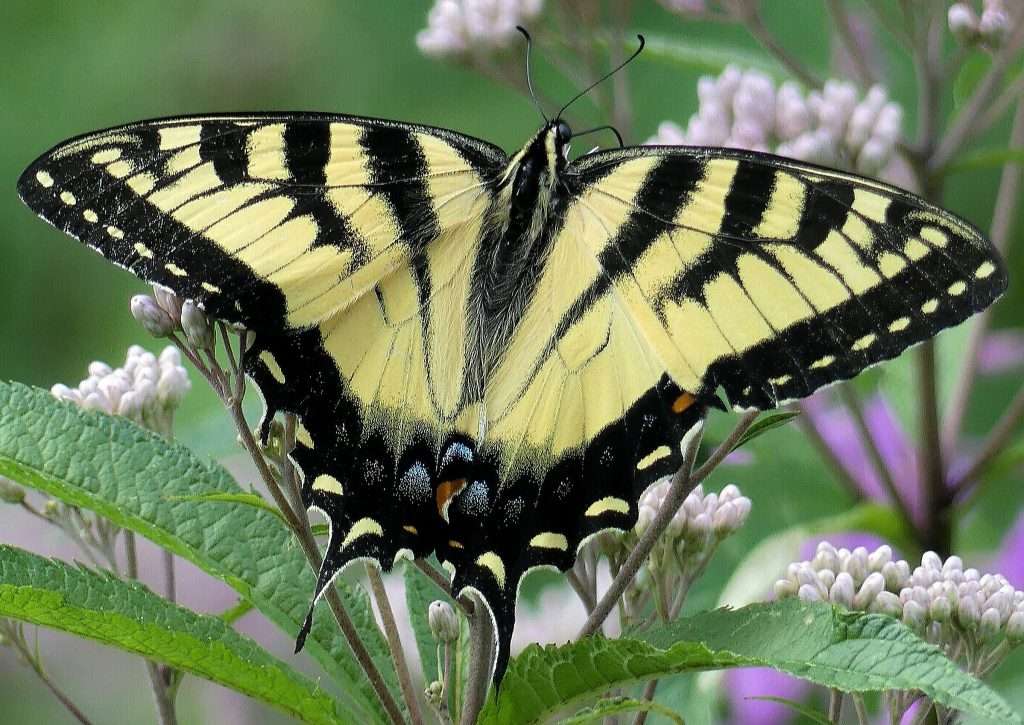
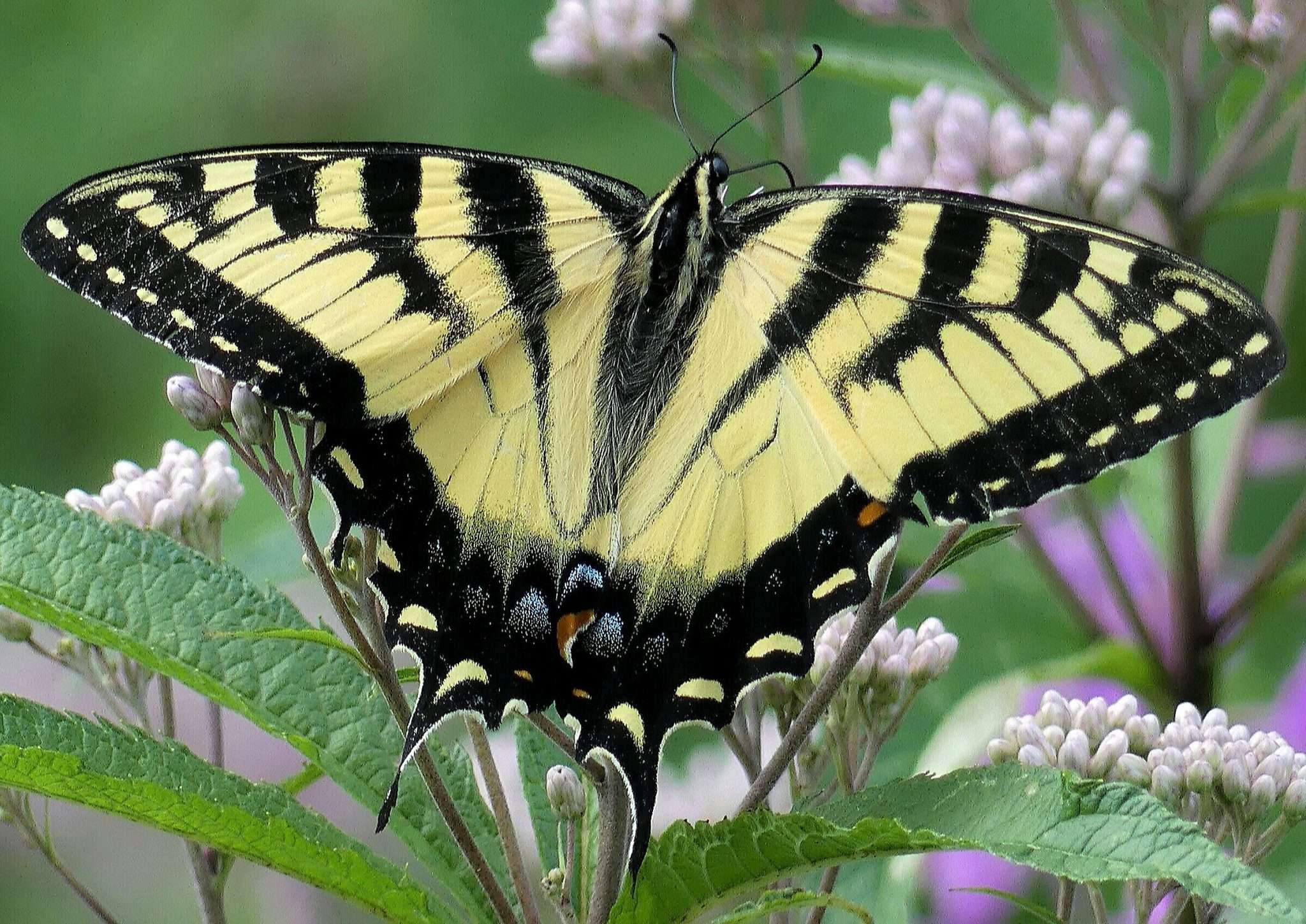
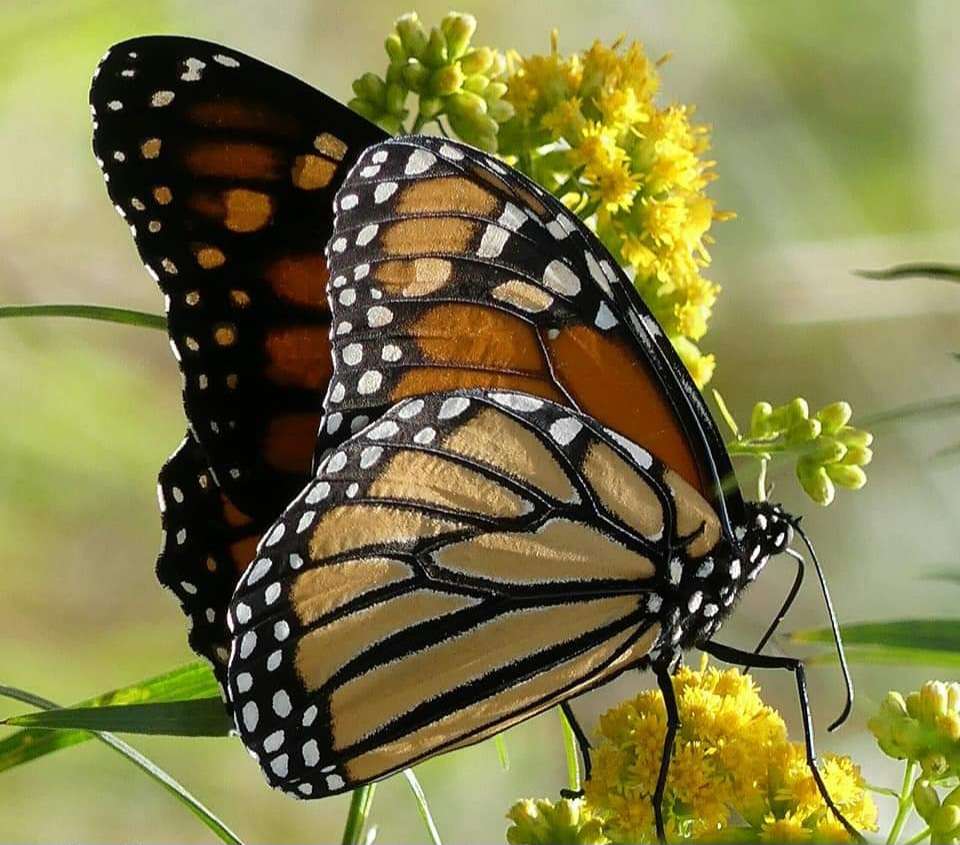
A familiar butterfly that may be seen in May or June is the Eastern Tiger Swallowtail (Papilio glaucus). It winters over as a chrysalis. Another butterfly which emerges early, is one that you or your child may have raised, it is a Painted Lady (Vanessa cardui). Perhaps you watched it change from a caterpillar (larva) and experienced the change from a pupa to an adult butterfly. We are truly fortunate in our area to be able to find many of the hundreds of North American species in our nearby woods, wetlands, meadows, and roadsides. Some species are extremely tiny, some are elusive, and others may be found near their host plants. All butterflies have a host plant, and some have more than one. The Monarch Butterfly lays one egg per plant of Common Milkweed; which is its host plant. The emerging larva will begin eating until almost the entire plant has been consumed. Milkweed contains all the necessary nutrients plus the toxic alkaloid known as cardiac glycoside. The cardiac glycoside doesn’t harm the monarch caterpillar but makes it toxic to most predators. Before the female monarch butterfly laid her egg she will taste the plant with her tarsi (claws) on her feet. The tarsi (tarsus singular) each contain the chemoreceptors for both smell and taste.
I hope that you will be able to find one or more of the butterflies which I have mentioned where you wander, too.

In 2007, she began working with the Black River Outdoor Educational Program (BROEP). In 2013 and 2014, she did a week-long summer program at BROEP with Mohawk Valley Community College (MVCC).
Using her love of nature and photography, she created a Flora/Fauna outdoor educational program teaching students (ages 6 to 14) the joys of nature and creative photography skills.
Joan’s love of nature has been a lifelong study of Birds, Wildflowers, Mosses, Ferns, Trees, Amphibians, Reptiles, Grasses, Insects, Spiders, Tracks, Scat, and Galls. She has assisted in cataloging all trails used by the hiking Coaches and photographed and identified seasonal Flora.
Since October 2016, she has written a bi-monthly nature column with Adirondack Express Newspaper. In October 2019, she began a bi-monthly column with the My Little Falls newspaper. You may reach her at jmhphoto8442@gmail.com.