

Story and Photographs By Joan Herrmann
Whereiwander… it has been extremely cold for several weeks, with temperatures well below zero. This means it is important for me to keep a full supply of suet and bird feeders filled. We also have a heated bird bath, which keeps a continual supply of water available. It is not usual to have as many as fourteen to twenty different species of small birds visiting throughout the day. I have been delighted many times to see some of the larger birds coming to get nourishment, too. In addition to Black Oil Sunflower Seeds and Suet, we also keep a large container filled with whole-kernel corn. Blue Jays, Crows, Ravens, and Wild Turkeys will all arrive throughout the day to eat the corn kernels. The Blue Jays and Crows generally arrive together, but I was truly surprised when I looked out and saw a Raven at the feeders.
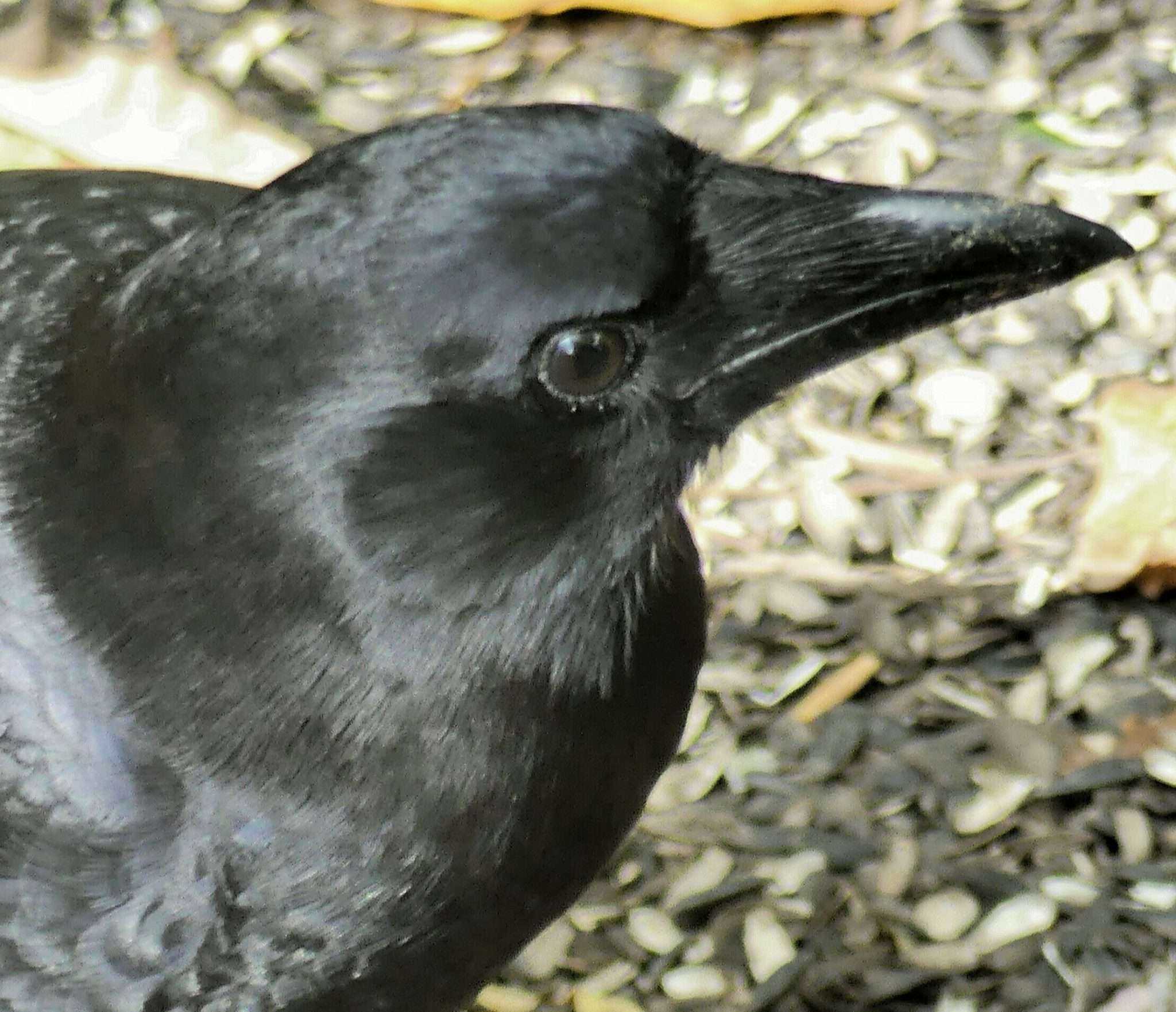
The Common or Northern Raven (Corvus corax) is a really large bird that is twenty-one to twenty-seven inches tall. The raven is entirely black and has a massive, thick bill. Compared to a Crow (Corvus brachyrhychos) that is seventeen to twenty-one inches tall. The crow does have a strong bill, but it is not as massive as the raven’s bill. In flight, the raven’s tail appears wedge-shaped, while the crow’s tail is square or slightly rounded. The caw-caw sound made by a crow is one that we may be familiar with, but it is nothing like the hoarse guttural sound of a raven.


It has been interesting learning about ravens; the first time I actually saw and heard them up close was from the hiking trail at the top of the gorge in Whetstone Gulf State Park, in Lewis County. The ravens were nesting on the ledges and as we approached the rim of the gorge the ravens began to react verbally and with great aerial vigor. I only took a few quick photos and we left, but we could still hear their admonishments.
Ravens are members of the Order Passeriformes, or perching birds, which are known by the configuration of their toes (three pointing forward and one pointing backward), which allow them to perch on a tree or other suitable objects. These fascinating and clever birds are mainly omnivores. They feed on carrion and carrion insects such as maggots and carrion beetles. They will also eat other insects, grains, berries, and fruits in addition to small mammals, nestlings, and occasionally garbage. They have been observed in fields following the plows and quickly eating the insects which have been disturbed. They are also opportunists and have been known to harass turkey vultures, which will vomit as a means of self-defense. After the vulture regurgitates the raven will consume the previously eaten food. They are even notorious for annoying domestic animals in order to steal food from them. Working in pairs, they have been seen distracting a nesting bird; once it has left the nest to chase the attacker, then another raven will grab the now unattended egg or nestling. This action may be the explanation for a flock of ravens’ name, which is “Unkindness’ or a ‘Conspiracy.” Their cleverness is seen in many different ways, including the fact that ravens are able to mimic sounds and human speech. When wary of a predator at a carrion site, they will patiently wait until crows or jays have approached first; if safe, they will chase the smaller birds away and begin feeding.
Aerial acrobatics are important in their courting behavior as well as their ability to procure food. Once they are paired, the two will most likely mate for life, using the same site and nest. The nest is made of large sticks and twigs with a deep bowled-shaped center. The bowl is filled with soft material such as deer hair or sometimes sheep or alpaca fibers. Cliff ledges are preferred nesting sites, although big trees or abandoned buildings have also housed their nests. Three to seven pale bluish-green speckled with brown streaking eggs are laid and incubated by the female. Incubation is generally eighteen to twenty-one days. After hatching, both the female and male will feed the nestlings, who will fledge for between thirty-five and forty-two days. The fledglings may stay with the adults for six months or more, with perhaps one staying with the adults to help with the next brood.
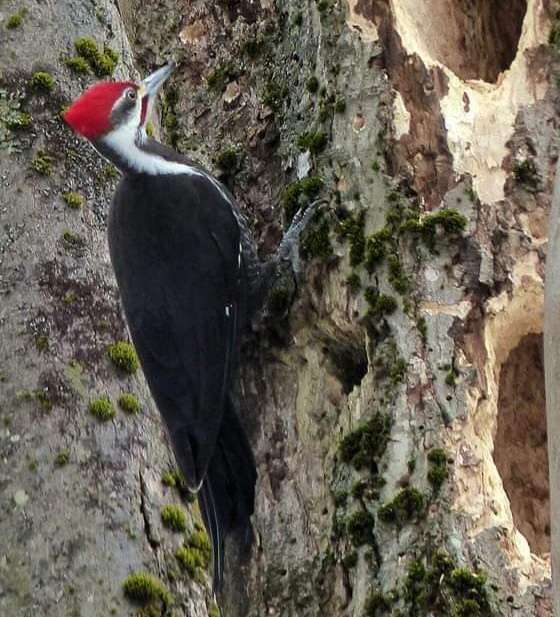
Another big bird that may occasionally check out our feeding area is a Pileated Woodpecker (Dryocopus pileatus), but it is more interested in suet than seeds. This large woodpecker’s diet as an omnivore consists of insects, especially carpenter ants and wood-boring beetles. It also consumes fruits and berries, which may include poison ivy, sumac, and bittersweet. The evidence that a pileated woodpecker is visiting your neighborhood is an extremely large rectangular hole appearing in a tree and enormous piles of wood chips below on the ground. The woodpecker will chip away until it has located the ant galleries within an infected tree. It then uses its long barbed tongue and sticky saliva to extract the ants. The rectangular cavities may eventually be used as a nesting site by other birds or small mammals. I found one in our neighborhood that had been claimed by a snake.
The pileated is about seventeen inches in height. Its body is mostly black, and it has a large red crest and white neck stripes. The male has a red mustache and red forehead, while the female has a black mustache and black forehead; this is one way to tell the male and female apart. The pileated woodpecker is the model for the Woody Woodpecker cartoon character, and its call is similar to the cartoon’s laughing sound. The name pileated may be pronounced either as Pie-lee-ay-ted or Pill-ee-ay-tid.
Pileated woodpeckers can withstand the blows to its brain when pecking and removing large wood chunks without brain damage. Scientists have studied this bird in hopes of replicating and improving the safety features in cars. The woodpeckers’ thick neck muscles diffuse the blow and a third inner eyelid prevent the eyeball from popping out plus a spongy bone cushions the brain like a football helmet. They dig their sharp claws into the tree and use their tail as a brace.

In 2007, she began working with the Black River Outdoor Educational Program (BROEP). In 2013 and 2014, she did a week-long summer program at BROEP with Mohawk Valley Community College (MVCC).
Using her love of nature and photography, she created a Flora/Fauna outdoor educational program teaching students (ages 6 to 14) the joys of nature and creative photography skills.
Joan’s love of nature has been a lifelong study of Birds, Wildflowers, Mosses, Ferns, Trees, Amphibians, Reptiles, Grasses, Insects, Spiders, Tracks, Scat, and Galls. She has assisted in cataloging all trails used by the hiking Coaches and photographed and identified seasonal Flora.
Since October 2016, she has written a bi-monthly nature column with Adirondack Express Newspaper. In October 2019, she began a bi-monthly column with the My Little Falls newspaper. You may reach her at jmhphoto8442@gmail.com.