


Story and Photographs By Joan Herrmann
Whereiwander… finally, the snow is melting, so I can wander once again. We had enormous amounts of snow this year. The balcony had as much as seven feet of snow which kept me from refilling the bird feeders. After my husband had shoveled all fourteen steps and a path to the living room door the next morning, it was totally filled in again. I then put a boot tray on top of the snow and poured sunflower seeds, whole-kernel corn, and unsalted/unshelled peanuts onto the tray. They found the food within minutes. Once, when I checked the tray, I saw a wild turkey on the tray. It was consuming the whole kernel corn.
Like many of you I am so delighted to see the migratory birds return. Among those early arrivals are Robins, Red-winged Black Birds, Canada Geese, and an assortment of Ducks. It is usually the males of these species that arrive first to select prime breeding sites.
But, my favorite migratory returnees are the Turkey Vultures (Cathartes aura). At first glance, this huge soaring bird may resemble an eagle, but upon closer inspection, the wings tips have “fingers,” which confirms its identity. Both the male and female vultures are similar in appearance. They have the same coloring and dimensions. Their head is small in proportion to the rest of their body. The lack of feathers on their head allows them to plunge their head into the carcasses of dead animals when feeding upon them. They have short curved bills which are capable of tearing flesh from the carrion (dead animals). Their nostrils are prominent and are not divided by a septum but are perforated, meaning that you can see sideways through their beak. Their eye color is a grayish brown, with a single spare row of eyelashes on the upper lid and two rows on the lower lid. Their legs and feet are a whitish pink color with one very long front toe, two shorter toes on both sides and one rear-facing toe; this configuration is known as an anisodactyly digit arrangement.
Their tracks are about three and a half to five and a half inches in length and about three to four inches in width. Immature turkey vultures have gray heads, and their bill has a black tip. Captive turkey vultures have been known to live to be forty years old, and in the wild, a previously banded bird that was recaptured was found to be sixteen years old, and it is thought that they may live as long as thirty years in the wild.
They make minimal sounds because they lack a syrinx. We have a larynx that allows us to produce sounds with our vocal cords stretched horizontally from back to front across it. Birds have syrinx which is located at the base of its trachea for producing sounds. Because they lack a syrinx the turkey vulture can only produce hissing or grunting sounds. They can be heard hissing when they feel threatened or when fighting over food. Grunts are the sounds heard from hungry young or from adults during courtship displays.
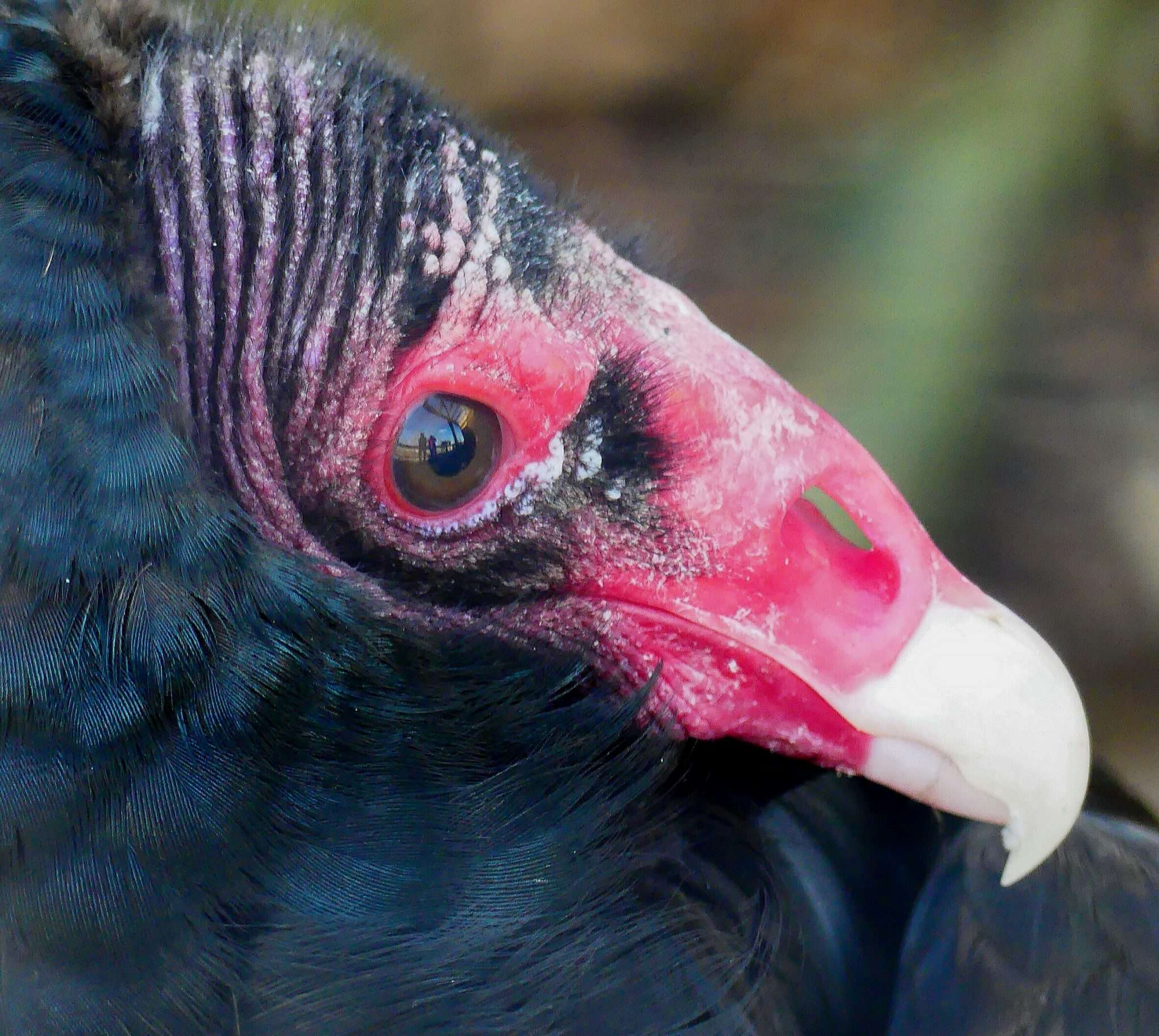

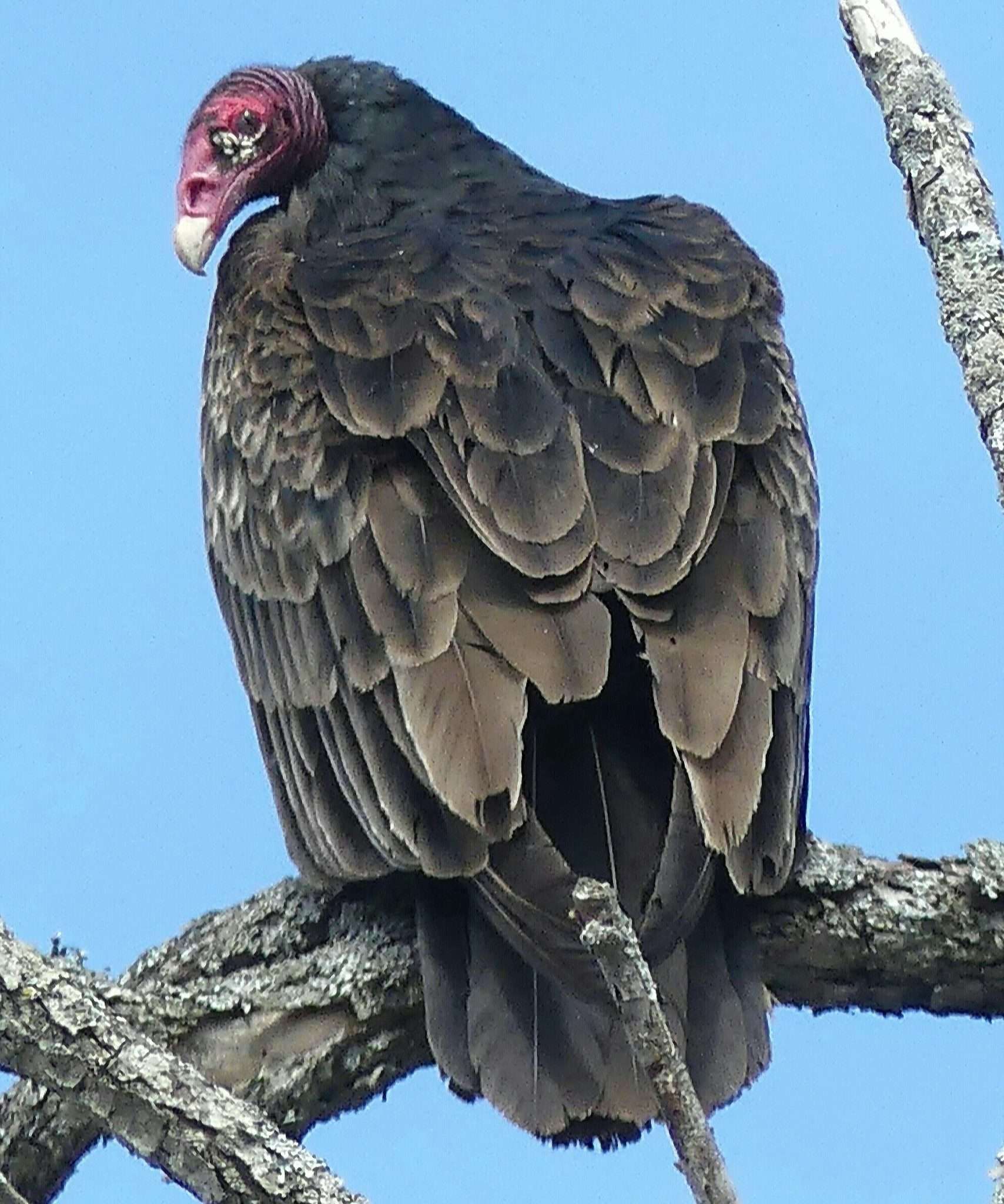

Turkey vultures may be found in North America, from southern Canada to Cape Horn. They migrate from our area each fall and return in early spring. They may be found in forests, pastures, grasslands, and wetlands. They are sociable and roost in large communal groups. After a rain they can be seen in groups spreading their wings to dry, this grouping is known as a “wake”.
Turkey vultures may also be seen with wings spread to “bake off bacteria” after feeding. They are also able to kill bacteria and lower their own body temperature in hot weather by urination on their own legs; this process is called urohidrosis. If a turkey vulture feels threatened, it can regurgitate (vomit) semi-digested, putrid-smelling meat, which may be irritating to the skin or eyes of the intruder.
Occasionally, they will regurgitate undigested meat from their crop to assist them in taking flight. They have few predators other than great horned owls, eagles, and red-tailed hawks as adults. But as nestlings and eggs, they may be preyed upon by raccoons, opossums, and gray foxes. They usually appear awkward while they are on the ground using a jumping-hopping stride, but when they take to the air, they are magical. That’s when Nature’s “sanitary engineers” become prima donna ballerinas, soaring and gliding on rising therms.
Turkey vulture habitat is generally in a remote area, the more inaccessible the better. My husband and I encountered a habitat a number of years ago while we were hiking not far from Braddock’s Bay. Our dog began tugging on his leash. He managed to pull me into a tangled grape vine-covered shrubbery area, which was a sight I have never forgotten. It was creepy and foul-smelling, but our dog was captivated. I managed to drag him from this disgusting but memorable sight.
The vulture’s nests are sparse, or just only eggs are merely laid on the ground upon dried leaves. Sometimes, they are laid on stumps or in hollow logs. They typically lay two, rarely one or three, long oval-shaped eggs, which are cream-colored with spots or blotches.
Both parents incubate the eggs for about five to six weeks. Their diet of dead animals is regurgitated and fed to the hatchlings. The hatchlings are born immobile, downy and with eyes closed, this is known as semialtricial. They grow quickly and will be able to fly within sixty-six to sixty-eight days.
Turkey vultures can find food (carrion) by both sight and smell. The ability to smell is found in the nasal passages of most birds, but it is highly developed in turkey vultures. Researchers have learned to exploit the keen sense of smell in pinpointing leaks in gas lines. Ethyl mercaptan, which is a chemical smelling like rotten meat, can be pumped into pipelines while checking the lines for leaks. If congregating turkey vultures are spotted, it may be a sign of a leak in the line.
Turkey vulture’s olfactory glands are so highly developed they can find carrion, which is at least a mile away. Even though their food is carrion they are extremely picky and will not eat it if it is too rotted, they prefer carcasses that are twelve to twenty-four hours old.
These are just a few of the reasons that turkey vultures are one of my favorite spring birds.

In 2007, she began working with the Black River Outdoor Educational Program (BROEP). In 2013 and 2014, she did a week-long summer program at BROEP with Mohawk Valley Community College (MVCC).
Using her love of nature and photography, she created a Flora/Fauna outdoor educational program teaching students (ages 6 to 14) the joys of nature and creative photography skills.
Joan’s love of nature has been a lifelong study of Birds, Wildflowers, Mosses, Ferns, Trees, Amphibians, Reptiles, Grasses, Insects, Spiders, Tracks, Scat, and Galls. She has assisted in cataloging all trails used by the hiking Coaches and photographed and identified seasonal Flora.
Since October 2016, she has written a bi-monthly nature column with Adirondack Express Newspaper. In October 2019, she began a bi-monthly column with the My Little Falls newspaper. You may reach her at jmhphoto8442@gmail.com.