


Story and Photographs By Joan Herrmann
Whereiwander… today it is in search of a favorite, which may be in or around the area of the Hinckley Dam and Reservoir. What I am hoping to find is one or more of the birds, which is our National Emblem, the Bald Eagle (Haliaeetus leucophalus). It is such a joy to be able to find and photograph this bird, especially since it has only been the last two decades that they have been slowly returning to our area and have been quite successful at reproducing nestlings. Eagles do not migrate and may be found sitting in tall trees over open water to hunt for their favorite food which is fish. Just like all raptors, eagles are strictly carnivores (meat eaters). They will hunt and eat small mammals and birds in addition to fish. They are particularly fond of waterfowl, mainly ducks of all species. Occasionally, when they experience frigid weather that freezes the deepest water, they must depend on other food sources. One of these sources might be road kill or a large mammal that may have died of starvation.
As a raptor (meat eater) eagles have another common trait which is the female is always much larger than the male. However, unless they are in close proximity, it may be difficult to determine whether you are viewing a male or a female. Both the mature female and male have dark brown torso feathers in addition to a white head, neck and tail feathers. Each has a yellow bill and cere (fleshy area between the bill and the face). The cere has oval-shaped openings, which are called nares. The nares are the entrance to the respiratory system. Air passes through their lungs twice within each breathing cycle. The adult eagles have light yellow eyes. An immature eagle doesn’t have these mature characteristics until it is five years old. Within four months of hatching from its egg, and just before it fledges (becomes ready to leave the nest), an eaglet grows and changes appearance three times. The hatchlings emerge with pale gray down, but within a few weeks, they molt into thicker, darker gray down. When they have grown in height and weight, they will be ready to leave their nest. Their molted brown and white feathers will have replaced the shade of gray down. The males are the first to leave the nest; they will fledge within nine to twelve weeks of age, while the larger females will fledge at ten to twelve plus weeks after hatching. The immature eagle’s bill, cere and eyes are brown and will change to yellow when they reach maturity.
Another commonality among raptors is that they are solitary birds. The males and females are seldom seen together except during courting and mating times, which will occur within the next few weeks. You may have an opportunity to see and photograph the two together in the same tree and if she is agreeable on the same branch together. If mating does occur the pair will then begin the ritual of building a nest or refreshing a formerly used nest. The male will bring gifts of sticks for the female to use in the nest. In our area, a nest is quite often located in the upper part of a White Pine Tree. A previously used nest is just covered over by new plant material and reused. Nest building by both males and females bonds the pair. Both adults take turns incubating the eggs. Once the eggs have hatched the adults will share the hunting and feeding of the eaglets. They can leave the nestlings in the nest by themselves within a few weeks, as their talons and sharp bill can protect them from most predators. During the first few days after hatching, the adults will remove fecal sacs to keep the nestlings from fouling their nest, but within a short period of time, the chicks will jump to the side of the nest and squirt the fecal matter out of the nest by themselves.
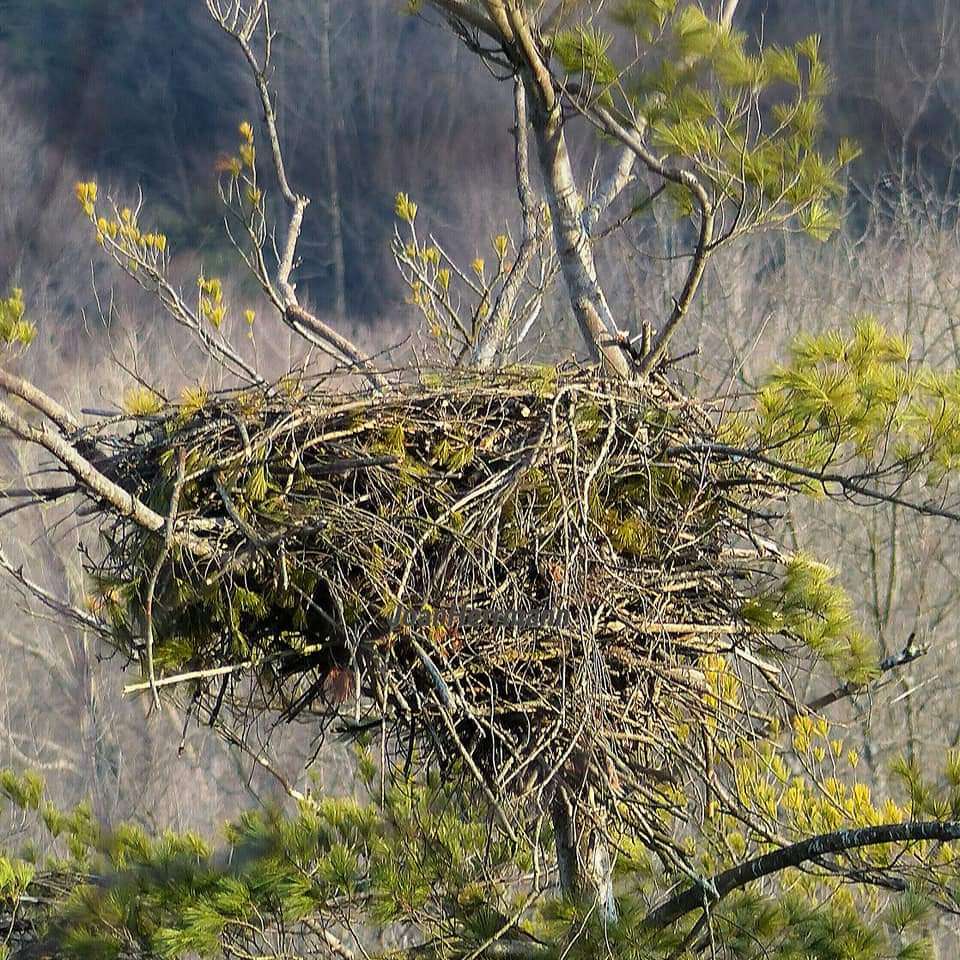
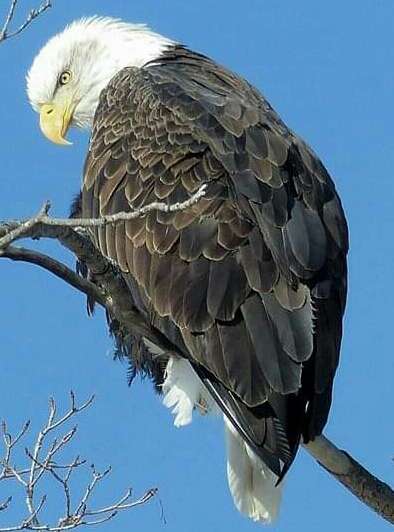
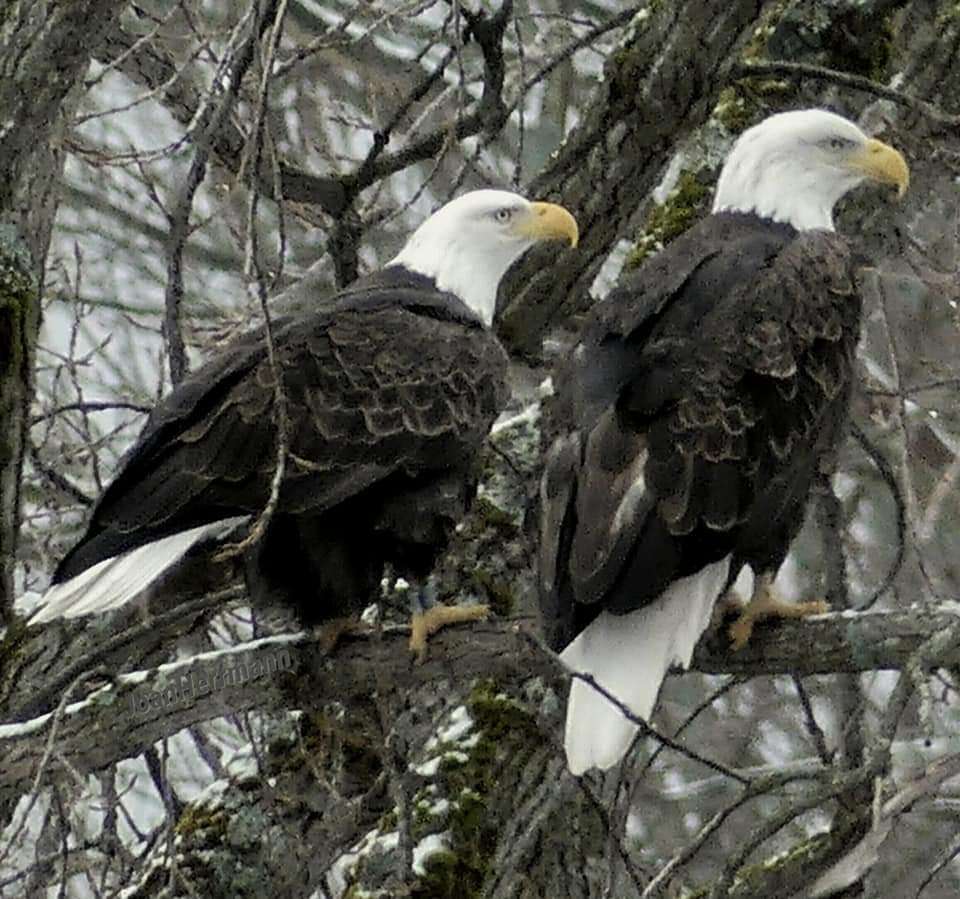
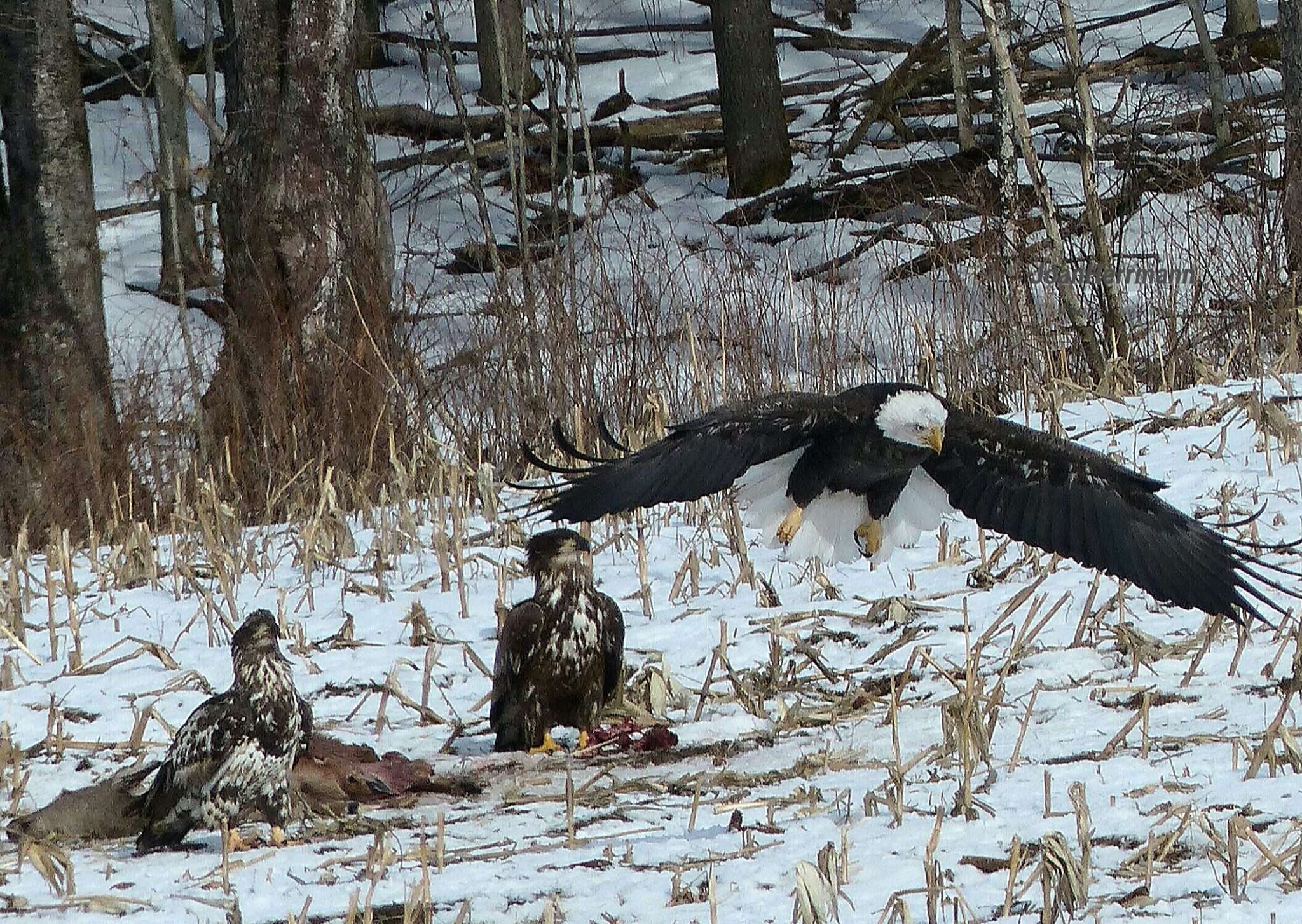
The average female is thirty-five to thirty-seven inches in height while the male is thirty to thirty-four inches in height. The female’s wing span varies from seventy-nine to ninety inches, while the male’s wing span is seventy-two to eighty-five inches. Eagles glide and soar using updrafts and currents. They can soar for long periods of time while hunting for prey. Their tail feathers are also important to flight acting as the stabilizing factor when they dive or swoop after the quarry. Tail feathers also assist with braking when the eagle lands. Although the eagle is not considered to be among the fastest of fliers they excel in their ability to glide and soar for hours; a bonus while hunting and for energy reserves. Perhaps you have heard the idiom “light as a feather,” which is true, as feathers are truly light. The eagle’s feathers are light and so is its skeleton. The eagle’s bones are hollow and extremely strong; however, its entire skeleton weighs less than all of its feathers. The average female weighs about twelve pounds, and the male weighs about nine pounds.
Fish, small mammals, and waterfowl are some of the food the adults will feed the nestlings. Eagles eat flesh and bones at all ages for calcium. The extremely high acidity in the stomach of an eagle also allows them to eat road kill and carrion without a risk of bacterial contamination. Adult eagles may consume one-half to three-fourths of a pound of food in one day. When rearing the nestlings, the adult can gorge itself and consume a pound of fish in as little as four minutes. After the gorging it may not eat again for a day or two days. Like owls, eagles also digest their food in their crop and will eliminate the undigested body parts (hair etc.) as a pellet.
An eagle’s eyesight is amazing. They have the capability to see both forward and to the side at the same time. Their hearing, although not as acute as an owl, is excellent. The eagles’ life expectancy is about twenty years, and they will generally mate for life; however, if their mate dies, they may find a new mate.
I hope you may have an opportunity to see and photograph these amazing birds.

In 2007, she began working with the Black River Outdoor Educational Program (BROEP). In 2013 and 2014, she did a week-long summer program at BROEP with Mohawk Valley Community College (MVCC).
Using her love of nature and photography, she created a Flora/Fauna outdoor educational program teaching students (ages 6 to 14) the joys of nature and creative photography skills.
Joan’s love of nature has been a lifelong study of Birds, Wildflowers, Mosses, Ferns, Trees, Amphibians, Reptiles, Grasses, Insects, Spiders, Tracks, Scat, and Galls. She has assisted in cataloging all trails used by the hiking Coaches and photographed and identified seasonal Flora.
Since October 2016, she has written a bi-monthly nature column with Adirondack Express Newspaper. In October 2019, she began a bi-monthly column with the My Little Falls newspaper. You may reach her at jmhphoto8442@gmail.com.