
Story and Photographs By Joan Herrmann
Whereiwander… today will be to several different habitats which may include my gardens, woods, and wetlands to find and photograph some beautiful plants. Our area has numerous wildflowers which are now in bloom and we also have some of the hundreds of ferns which are also unfurling. Learning to identify each fern species has become easier because there are now many fern field guides that are extremely helpful with photos and other identifying features, too. Ferns have a lengthy history; scientists have found fossils of ferns that are more than two hundred million years old. Interrupted ferns, which can easily be found in our area, have been found in fossils in Antarctica, which look exactly like the ones you may find growing along the side of a path on an Adirondack trail or elsewhere throughout the northeast.
Ferns are vascular plants that reproduce by way of spores; they do not have seeds or flowers. Vascular plants have tissue for conducting water and minerals throughout the plant. Unlike seed plants ferns produce thousands of spores which scatter in a breeze, caused or by an animal brushing up against them. The spores may be carried to a suitable spot, where, under the right conditions, they will begin their life as a gametophyte; then, after many cycles, a tiny fern may begin to grow. The case that holds the spore is call sorus (sori plural) and it can be useful to aid with identification of many different species.


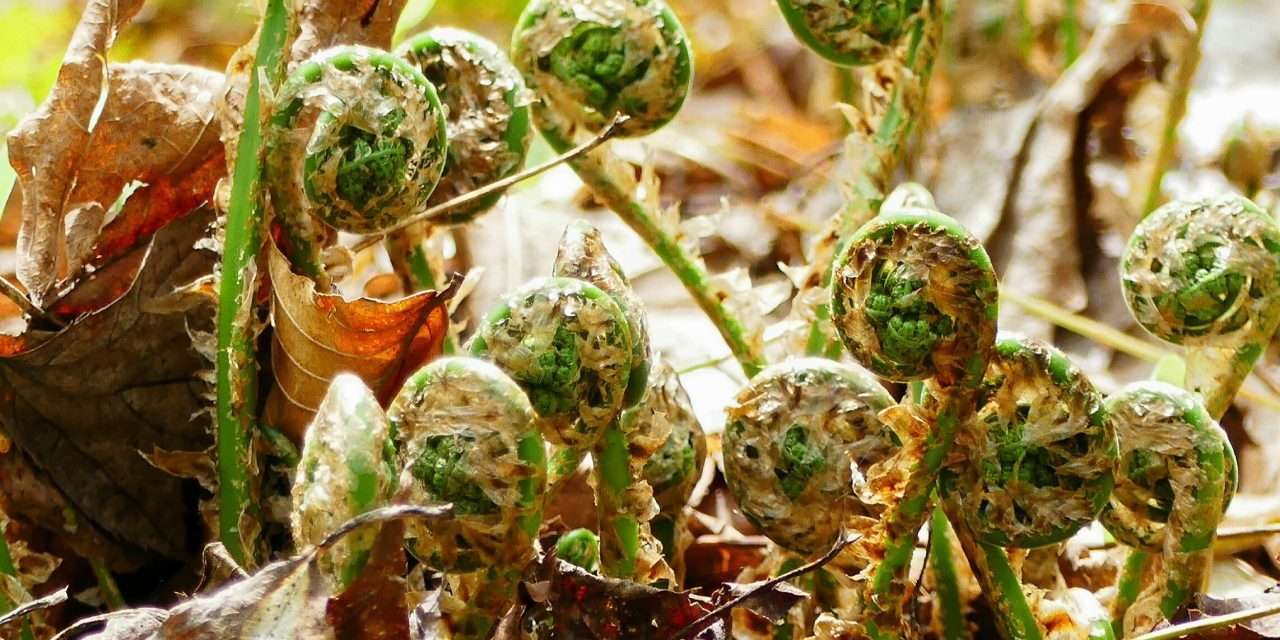
Many species by now have already pushed their way through the soil and have unfurled. The name fiddlehead comes from their shape, which is thought to resemble the scroll on the end of a stringed instrument such as a fiddle or violin. The shape has also been referred to as a crosier which is a staff used by a Bishop or Shepherd. Fiddleheads can be found in several colors, from the bright green of Ostrich Fern (Matteuccia struthiopteris) to the gray-green of Christmas Fern (Polystichum acrostichoides) and the burgundy color of Sensitive Fern (Onoclea sensibilis). Some fiddleheads are smooth with a brittle papery covering, and others are fuzzy in appearance. Ostrich Fern fiddleheads are recognized as an edible spring vegetable, tasting a bit like asparagus or broccoli. However, the fuzzy Christmas or Cinnamon fern fiddleheads are definitely not edible. Unless you are with someone who knows which fiddleheads are edible, it is advisable to purchase them from a grocery or outdoor market.
In the spring, the fiddleheads that push through the ground continue to grow and unfurl to become the fronds or leafy part of the fern. Other parts of the fern include the stripe, which is similar to a stem, growing up from the ground to the leafy part which is named the blade. The blade contains both the rachis (the stem area from which leaves grow on either side) and the leaves. The leaves are called pinnae, and the individual part of the pinna is called a pinnule. In some species, the fertile sori can be found on the pinnules. In other ferns known as Osmunda ferns, the fronds are sterile, and fertile sori are found on the stalks either surrounded by the fronds or in the Interrupted fern, they are within the middle of the leafy fronds.
Some of the ferns that you may encounter while hiking on local trails may include many of my favorites such as Maidenhair fern (Adiantum pedatum) it is also growing in our shaded woodland gardens in addition to growing in our sunny rock wall garden. It may also be found growing near streams and waterfalls throughout the Adirondacks. Its graceful shape reminds me of a pinwheel. Adiantum, its genus name, comes from the Greek word meaning “not wetting” and refers to the frond’s ability to shed water without becoming wet. Their stripes (the portion growing out of the ground to the leafy area) are often black, and the rachis is black or green. It grows to be twelve to thirty inches tall. Maidenhair fern was once considered a cure for baldness. It is not an evergreen, and the plant will die back after a hard frost.
Rock Polypody (Polypodium virginianum), also known as rock cap fern, can be found growing on glacial erratics (boulders) that may be found throughout the Adirondacks. Rock Polypody is an evergreen and can be seen all year round. Their large circular sori can be found on the undersides of the fronds. Polypody can survive extreme drought conditions. Its leaves roll up with the lack of moisture, unrolling when it becomes available. Its fronds are sometimes eaten by deer, grouse, and turkeys.
Christmas fern (Polystichum acrostichoides) is an evergreen fern and is common throughout the Adirondacks. Its fronds were once harvested to make Christmas wreaths. The fronds stay green all winter and will die back once the springtime new fronds unfurl. Its sori can be found on the undersides of the pinnules, which are thought to resemble a Christmas stocking. Its fronds are also a food source for wildlife.
The three Osmunda ferns that may be found in our area are Interrupted Fern (Osmunda claytoniana), Cinnamon Fern (Osmunda cinnamomea), and Royal Fern (Osmunda spectabilis). Interrupted Fern gets its species name from John Clayton, an English-born botanist who lived in Virginia, and the common name from the “interrupted” gap in the middle of the blade where the fertile portions of the plant are located. This fern is sixteen to forty inches tall. Cinnamon Fern has both sterile fronds and fertile spore-bearing fronds which when mature are a lovely cinnamon color. The fertile fronds stand erect, are shorter, and are surrounded by green sterile fronds. The sterile fronds will begin to die after the first frost, but the fertile fronds will remain until the next season. Native Americans used Cinnamon Fern as a cold remedy and as a remedy for snake bites. Royal Fern also has both fertile and sterile fronds and prefers a wetter environment. Look for it in bogs and wetlands and along the edges of ponds and streams.
I hope that you will have some nice adventures looking for and identifying some of these ferns.
 Joan Herrmann has taught and done programs for Schools, Garden Clubs, Libraries, and Nature Centers for about 38 years as a Professional Nature Photographer, Naturalist, and Outdoor Educator. After moving from the Rochester area in 1995, she began her Photography business, Essence of Nature, and became a co-owner of The Artworks in Old Forge, New York. As a docent at Munson, Williams, Proctor Arts Institute in Utica, New York, she has been educating children and adults for nineteen years.
In 2007, she began working with the Black River Outdoor Educational Program (BROEP). In 2013 and 2014, she did a week-long summer program at BROEP with Mohawk Valley Community College (MVCC).
Using her love of nature and photography, she created a Flora/Fauna outdoor educational program teaching students (ages 6 to 14) the joys of nature and creative photography skills.
Joan’s love of nature has been a lifelong study of Birds, Wildflowers, Mosses, Ferns, Trees, Amphibians, Reptiles, Grasses, Insects, Spiders, Tracks, Scat, and Galls. She has assisted in cataloging all trails used by the hiking Coaches and photographed and identified seasonal Flora.
Since October 2016, she has written a bi-monthly nature column with Adirondack Express Newspaper. In October 2019, she began a bi-monthly column with the My Little Falls newspaper. You may reach her at jmhphoto8442@gmail.com.