

When Abe Swartz was promoted to Assistant Chief in 1942, it was apparent he was being prepared to be Chief Cooney’s successor. At this point, Swartz had taken a more active leadership role at fires, since Cooney’s advancing age kept him on the administrative side of the department.
Early in the morning of May 10, 1945, Swartz would get a preview of life in the fire department without Chief Cooney. World War II in Europe ended two days before that morning, but while Cooney was in New York City, a fire broke out in the Feldman Furniture building. It was a four-story structure on the southeast corner of Albany and Second Streets (its main tenant today is River Hills Properties). The owners, Mannie and Harry Feldman were in the building until just a couple of hours before the fire.
Although it was May, a wet snow had been falling which caused the roof to leak. The Feldmans had been buckets throughout the third and fourth floors to catch the dripping water, and when they left there were no signs of trouble. At 12:40 a.m., William Perry, a night guard at the nearby Cherry-Burell plant (located at today’s Kinney’s and Dollar General parking lot), saw flames shooting out of the third floor of the store. Another guard, William Bacon, pulled fire alarm box 4.
The fire department, along with Mayor Wagoner and members of the Police and Fire Board, were soon on the scene and knew right away they were in for a long night. The fire had completely engulfed the third floor and was threatening to overtake the fourth floor as well. Both floors were loaded with furniture, furniture padding, and other flammable materials, making the fire intensely hot, fast-moving, and dangerous.
https://mylittlefalls.com/the-history-of-the-lffd-platoons-a-new-engine-and-another-deadly-fire/
While the firefighters were raising ladders and getting water on the fire, the Mayor and Commissioners decided to call the Herkimer Fire Department for assistance. Herkimer Chief Harry Vincent and two of his men responded with their brand-new aerial truck. The Herkimer machine was different from the Little Falls ladder truck in that Herkimer’s had a rotating telescopic “boon” as opposed to having only ground ladders.
The Herkimer truck proved very useful in getting water to the roof. When the blaze was brought under control, it gutted the third and fourth floors and burned off a quarter of the roof. No one was hurt, and no buildings in the vicinity were damaged – a testament to the great work done by the firefighters. The burned-out floors and roof of Feldman’s Furniture would be rebuilt and the store was re-opened. It was determined the leaking water from the roof had gotten into the wiring and sparked the destructive fire.
The decade of the 1940s would prove to be one of the most tragic in the history of Little Falls. That trend continued on January 10, 1946, with the collapse of the Adirondack Woolen Company warehouse on Moss Island. The four-story stone structure was being leased to the Storage In Transit Company by George Smith, who was the last owner of the Adirondack Woolen Company.
Storage In Transit was using the building to store wooden pulp bales that weighed between 350 and 400 pounds each. Believing they had an unlimited weight capacity, the company loaded the warehouse with hundreds of these bales, especially on the third and fourth floors. The weight capacity was not unlimited, and on that fateful afternoon, a rumbling noise was followed by a horrendous crash as part of the fourth floor crashed into the third.
Of the 14 men working on those two floors, eight were able to escape when the rumbling started – leaving six trapped in the massive amount of rubble. Calls were immediately placed to the fire and police departments, and they, along with several volunteers, began the rescue effort.
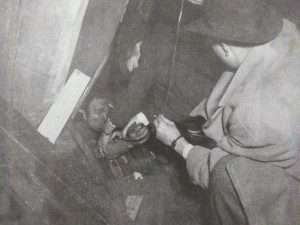
Carl Vogt is being tended to by a doctor at Adirondack Woolen Company collapse. Vogt would survive the ordeal.
A crane was called in from Utica, but it was delayed getting on-site because of its size and narrow accessibility. When it was all done, three men: James Vanese, James Mahar, and Clarence “Bucky” Wells died in the collapse, and a fourth man, Edward Weinschreider died while being transported to Little Falls Hospital.
The rescue efforts were not completely in vain, as two men, Carl Vogt and James Long, Jr. were pulled out alive. Long, a former callman in the fire department and son of former Police Chief James “Dusty” Long, was pulled out by Clarence Smith of the LFFD – with some help. Long’s nephew, David Dineen recalled that a handsaw was lowered to his uncle which he used to cut away the mangled wooden debris that had trapped him. Today, all that is left on the site is a brick structure that was attached to the main building.
UP NEXT: It’s the end of an era in the Little Falls Fire Department.