
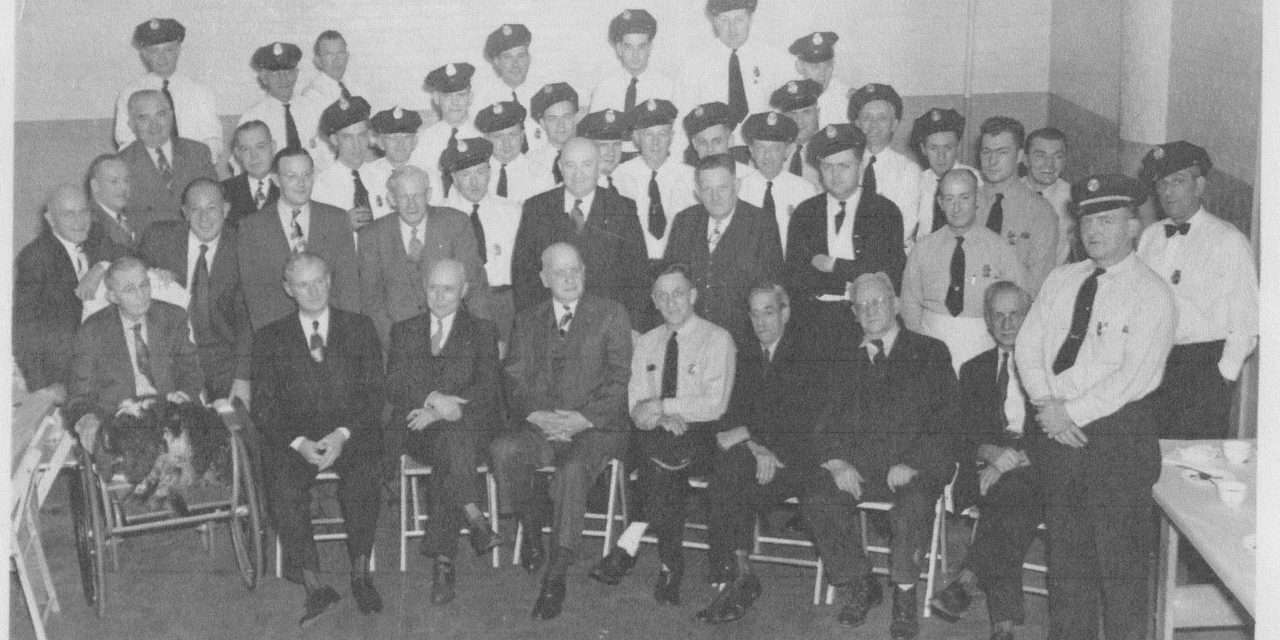
The retirement of Chief Cooney in 1947 brought widespread changes throughout the Little Falls Fire Department. Not only did the department have a new chief in Abe Swartz, but there would be a “changing of the guard” on the roster as well.
In 1948, Hugo Goering retired after 25 years of service. Paul Swancara and Dusan Osley were hired to fill roster spots, although neither would last long. Alfred Munger, who was hired in 1950, would last much longer, eventually succeeding Swartz as the head of the department.
The hiring would continue throughout the 1950s, as Earl Bacher was brought aboard after Munger. Ira Hoke was appointed in 1957, followed by Ray George and Anthony “Biscuit” Bisconti in 1958. John Grainer was a temporary firefighter in 1957 and 1958, and in 1959 Ed Brzdenk was made a full-time firefighter. By the end of the 1950s, the regular force (excluding the callmen) had grown to one Chief, three Assistant Chiefs, and six regular firefighters.
There would be promotions in the department during the Chief Swartz era as well. George Miller was promoted to Assistant Chief in 1955, followed by Alfred Munger and Stephen Talaba in 1959 and 1965. The promotions were needed to not only effectively manage the growing department but to eventually replace a long-time member and Assistant Chief.
On October 7, 1961, a retirement party was held at the DeCarlo-Staffo post for Assistant Chief Clarence Smith. Smith was on the job for over 40 years, as he joined the LFFD as a call man in 1920, and became regular in January of 1921. He was promoted to Assistant Chief in March of 1947 when Abe Swartz was named Chief.
Clarence Smith was heavily involved in the New York State Permanent Firemen’s Association (a forerunner of today’s NYSPFFA). He had held the titles of President, Vice-President, and Trustee. Smith was also a founding member of the Little Falls Lions Club.

Clarence Smith at the wheel of the 1928 ladder truck.
As mentioned in the last chapter, the Call Firemen (or Call Men) were reorganized in 1947. During the time of Chief Swartz, they went from a loose group of volunteers to a cohesive unit, and they became a presence in the community as well. They held fundraisers and as long-time call man Patsy Vennera recalled “we built the bleachers for the little league field from scratch.”
In 1959, Charles Van Slyke, a 30-year veteran of the department, was named Captain of the Call Men. It had been about 60 years since that position had been filled (call firefighters were a part of the paid department upon its inception, but became volunteers in the 1930’s), and it would never be filled again.
A legacy of this group was the banquets they held every year. Up until the 1920s, banquets, or “feeds” as they were called then, were occasionally held at the station. For whatever reason, these gatherings had faded away, but this group revived them. Once a year, the fire station turned into a banquet hall with the firefighters cooking and serving dinner to city officials, guests from other fire departments, and officials from neighboring municipalities. These banquets would develop into the dinner dances that were held annually until the 2010s. The dinner dances were not held at the fire station, but at various venues throughout the city and were a highly anticipated event.
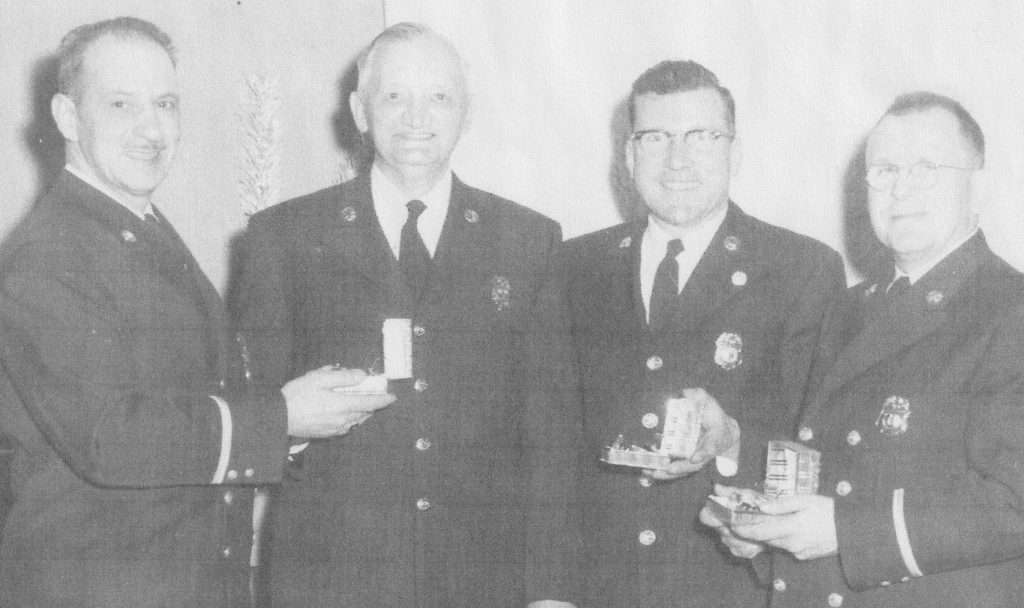
The Chaplain of the Little Falls Fire Department Anthony Franchi presents service awards to call firefighters Claude Miller, LeRoy Van Slyke, and Charles Van Slyke during a banquet in the 1960s.
Up next; a major fire scorches Hancock and Main Streets.
Special thanks to the Little Falls Historical Society for the access to their Cooney files and other materials.
I know a great deal about those banquets. My husband was several times chairman of the Call Firemen and Treasurer for many years. the Call men were proud of their trainings and fought hard and partied once a year. They used to hold “Union meetings” at the bar at the DeCarlo Staffo Post Home where many of the annual installation banquets were held. Members would gather around the bar and drink a shot to their former comrades or present comrades. It was a true brotherhood. Roger made a special wooden holder for twenty shot glasses. These men and woman had seen a great deal of sadness in their service to the city. They were the best!