
Story and Photographs By Joan Herrmann
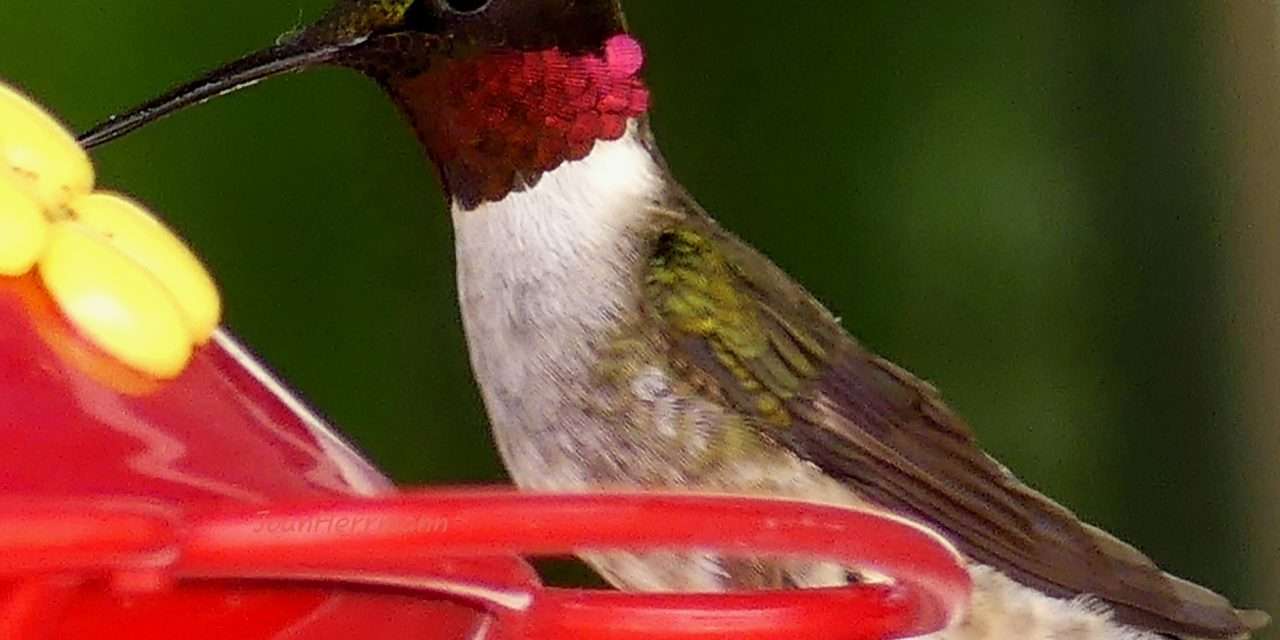
Whereiwander… we ignore “calendar spring” because it is seldom truly spring where we live. We have learned to be patient and not to expect to see the returning migratory birds or woodland blooms until late April or early May. Once again, that has chosen to be more plausible. I will be putting the Hummingbird feeders out this week. For the past 20-plus years, I have been joyful to see a male Hummingbird that has completed his amazing journey of flying nonstop over the now Gulf of America. We only have one species of hummingbirds that migrate to our area, and it is known as the Ruby-throated Hummingbird. It will have flown a distance of about five hundred miles. Before beginning its journey, it will double its body and will live off its own body fat while flying over the water. After migrating from Central America, it will take them about twenty hours, but they still have another long flight to reach our area.
Ruby–throated hummingbirds have a phenomenal metabolic rate, which is greater than that of any other animal. Their heart rate is about one thousand two hundred and sixty beats per minute, and their breathing rate is about two hundred and fifty breaths per minute, even while resting. Scientists have learned that during flight, the hummingbird consumes ten times more oxygen than human “elite athletes”. Their wings can beat fifty-three times per second as they hover and feed. In addition to flying forward, they can also fly backward and upside down. The male’s aerial mating display includes flying back and forth like a pendulum in front of the female until it is accepted, and then they will mate.
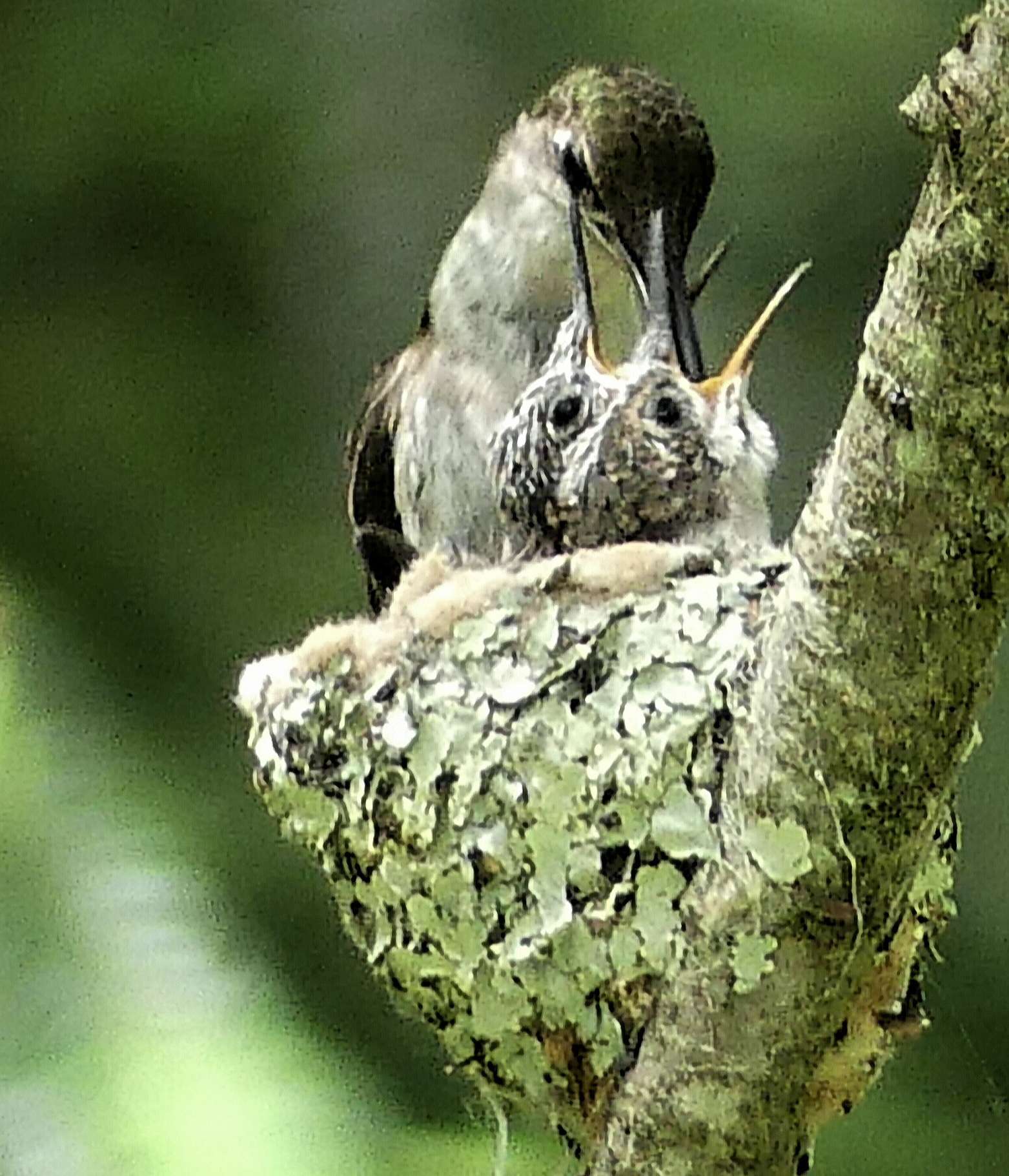
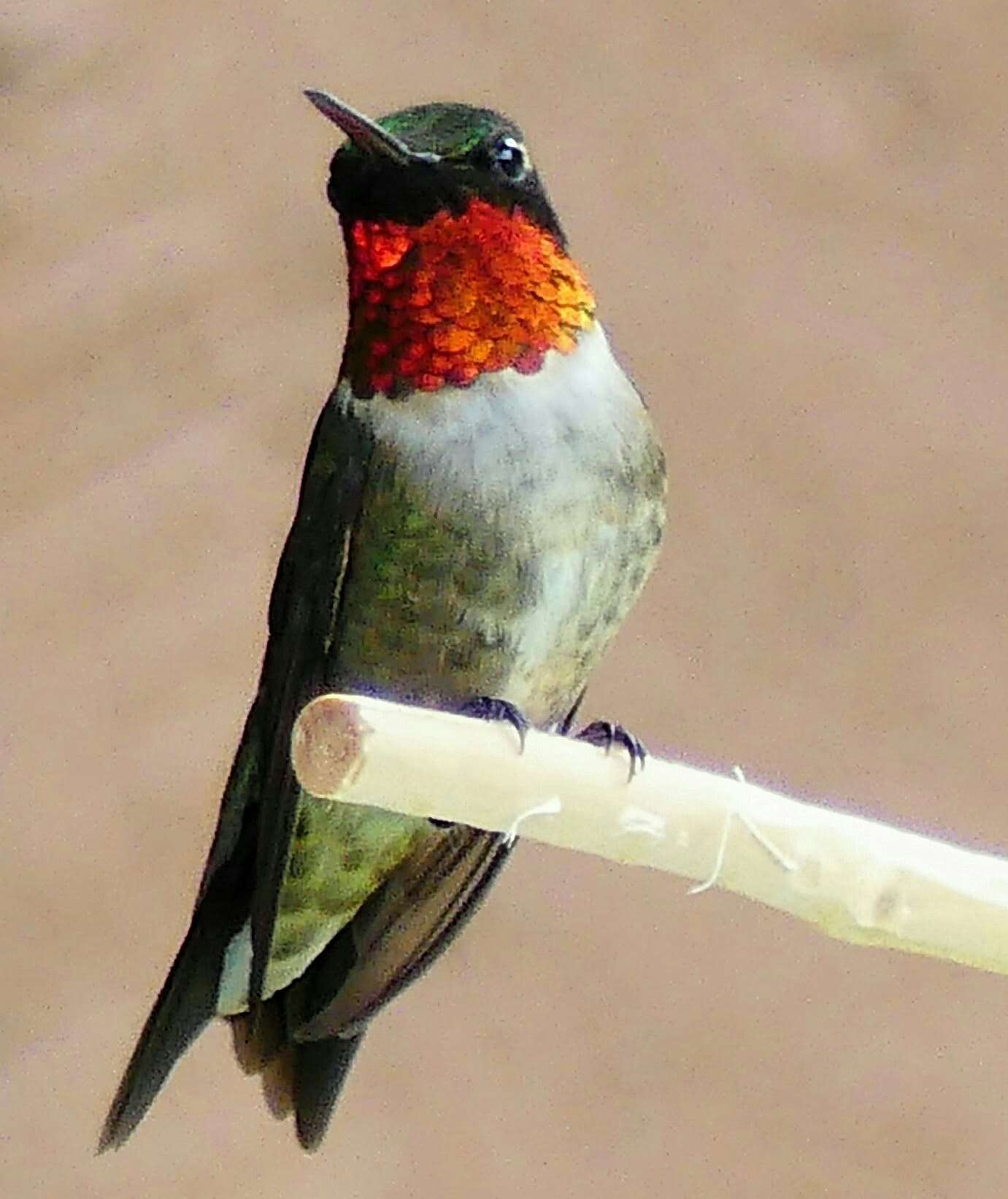

The males are polygamous and will mate with more than one female. The male will take no responsibility for nest making, incubating, or caring for the nestlings. The female is the architect designing her lichen-covered nest. She will lay two or sometimes three eggs, and sometimes she will reuse the same nest for a second brooding in the same season. The cup-shaped nest is about one inch in width and depth. She will assemble the nest with plant materials and spider webs, and cover the outside with greenish-gray lichen. The silky spider web allows for expansion of the nest as the nestlings begin to grow. She will line the inside of the nest with dandelion or colt’s foot downy seed fluff. The site of the nest will most often be in a mixed deciduous and coniferous forest. The nesting trees of choice are usually six to fifty feet tall, with ten to twenty feet being the average height. She attaches the nest to a small twig or branch that slants downward from the tree, and is sheltered above by leafy branches, and has an open area below the nesting site. It will take about seven to eight days for the female to complete her nest.
The eggs that she lays are glossy white and about the size of a white bean. She will incubate the eggs for approximately fourteen to sixteen days. The nestlings are born altricial, which means they are immobile, downless, with closed eyes, and need to be fed. For the first few days, shortly after being fed, the nestling will expel a fecal sac after eating. The female will remove the fecal sac, preventing the nest from being contaminated with feces. Approximately day three, the nestlings will move to the edge of the nest and squirt their waste over the side of the nest. The nestlings grow very quickly and need to be fed constantly. The female will retrieve nectar from flowers; find small insects like aphids and tiny spiders, working continually throughout the daylight hours to feed her hungry brood. Thankfully, they grow quickly and are ready to fledge within fourteen to twenty-eight days. At fledgling, they will be fully feathered and able to fly and find their own food. They will undoubtedly still beg for food, and she will teach them how and what to eat. Hummingbirds have a long and forked tongue. It is actually two times longer than its beak and is lined with “hair-like fringe” that is called lamellae. As the hummingbird extends its tongue into a tubular flower where the liquid nectar is found, the tongue laps up the nectar and pulls it back into its beak.
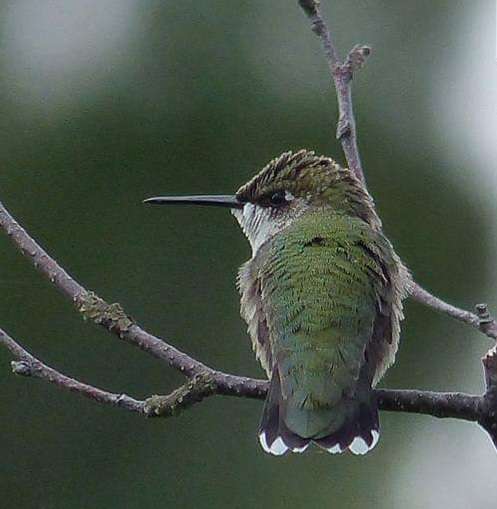
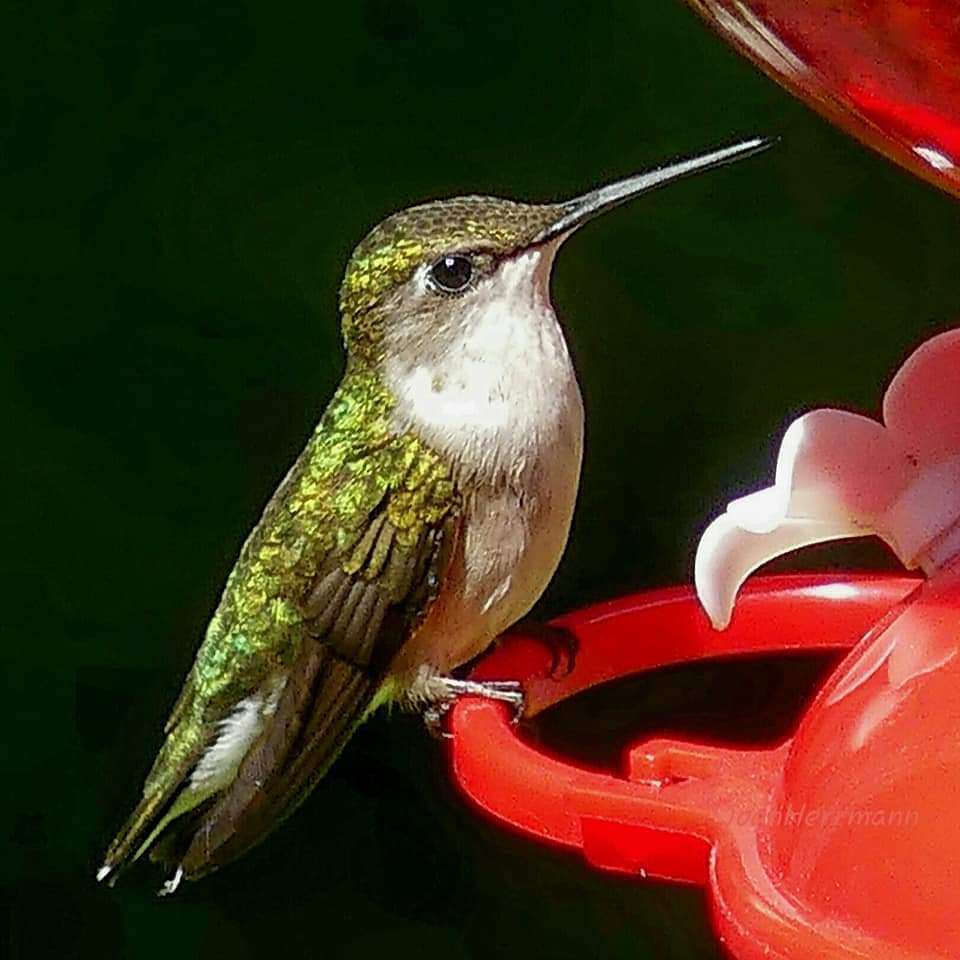
Male Ruby-throated Hummingbirds live about five years, and the life expectancy of the female is about nine years. Their tiny bodies are between 2.8 inches and 3.5 inches in length for males and 3.1 to 4.3 inches for females. The males’ weight is about 0.12 ounces, and the females are larger at 0.13 ounces. They are dimorphic, which means they are different in size and color. The male is an iridescent deeper green than the female and has a ruby colored gorget (throat patch), which, in certain lighting, may appear black. His chest is a sooty white color. The female coloring is a more limey green iridescent, and she also has a sooty white breast, but no gorget. They both have tiny feet, and even though they are most often seen flying or hovering, they can perch on a twig or on the provided perch of a hummingbird feeder. In winter, they molt their worn feathers and replace them with new ones. They can often be observed on a twig preening their feathers using their feet as a “comb” to scratch their neck or head.
Some of our native wildflowers that are preferred by the hummingbirds are Columbine (Aquilegia canadensis) in the Spring and both Red Cardinal Flower (Lobelia cardinalis) and Jewelweed/Spotted Touch-Me-Not (Impatiens capensis) in the Fall. Hummingbirds are instrumental in pollinating all three of these flowers because of their long beak and tongues. It becomes a symbiotic relationship for both, providing food for one and the continuation of the species for the other.
Some other interesting facts are that the males will depart for their winter habitat about a month before the females and the fledglings. Each species of hummingbird has a unique “humming sound” in flight due to the number of wing beats per species. The Ruby-throated hummingbird in flight beats its wings fifty-three beats per second. Now is a good time to clean and fill your hummingbird feeders.
 Joan Herrmann has taught and done programs for Schools, Garden Clubs, Libraries, and Nature Centers for about 38 years as a Professional Nature Photographer, Naturalist, and Outdoor Educator. After moving from the Rochester area in 1995, she began her Photography business, Essence of Nature, and became a co-owner of The Artworks in Old Forge, New York. As a docent at Munson, Williams, Proctor Arts Institute in Utica, New York, she has been educating children and adults for nineteen years.
In 2007, she began working with the Black River Outdoor Educational Program (BROEP). In 2013 and 2014, she did a week-long summer program at BROEP with Mohawk Valley Community College (MVCC).
Using her love of nature and photography, she created a Flora/Fauna outdoor educational program teaching students (ages 6 to 14) the joys of nature and creative photography skills.
Joan’s love of nature has been a lifelong study of Birds, Wildflowers, Mosses, Ferns, Trees, Amphibians, Reptiles, Grasses, Insects, Spiders, Tracks, Scat, and Galls. She has assisted in cataloging all trails used by the hiking Coaches and photographed and identified seasonal Flora.
Since October 2016, she has written a bi-monthly nature column with Adirondack Express Newspaper. In October 2019, she began a bi-monthly column with the My Little Falls newspaper. You may reach her at jmhphoto8442@gmail.com.