
Photographs and Story By Joan Hermann
Whereiwander… this is a great time of the year to find and photograph one of my favorite bird subjects. The numerous species of owls, which we can observe in our area within the next few weeks and months, are increasing, as many will be migrating. The Great Horned Owl, the Barred Owl, and the Eastern Screech are three that we may be able to find all year long. The tiny North Saw-whet is one that will leave the Adirondacks and may pass through our area while seeking warmer climates. Whereas the Snowy, Great Gray, and Boreal owls may seek our area as a better opportunity for prey and will migrate here.
The more I learn about owls and their choices of habitat and hunting techniques, the more likely I am to be able to find and photograph them. Owls have huge, exceedingly developed ears arranged asymmetrically (one ear higher than the other) on their head. They can hear potential prey, like a vole or mouse, rustling in the grass or scurrying under leaves or snow by means of their flattened facial disks that act to reflect those sounds to their ears. Their ears could be compared to a satellite disk bringing information to a television. One winter, I watched a Snowy Owl (Bubo scandiacus) that was on the top of a telephone pole. I watched as it turned its head to triangulate the sound of a vole under at least a foot of snow. It flew to the spot, reached into the snow with its talons, and brought up the prey. It then returned to the pole, transferred the vole to its mouth, and swallowed it, head first, whole.
Owls use sight and sound to the maximum. An owl can see as well as a human in daylight but probably a hundred times greater than humans in dimmed light. Owls have extremely large eyes which are positioned in front of their face, whereas most birds have eyes on either side of their head. But that isn’t a problem for the owl as it has extra vertebrae in its neck, which allows it to rotate its head about two hundred and seventy degrees in both directions.
Owls are able to fly without making a sound. Their soft, velvety feathers absorb high-frequency sound, and the edges of their primary feathers are serrated to muffle sound as the wings pass through the air. Even their legs and feet are feathered, allowing the talons to create a soundless approach.

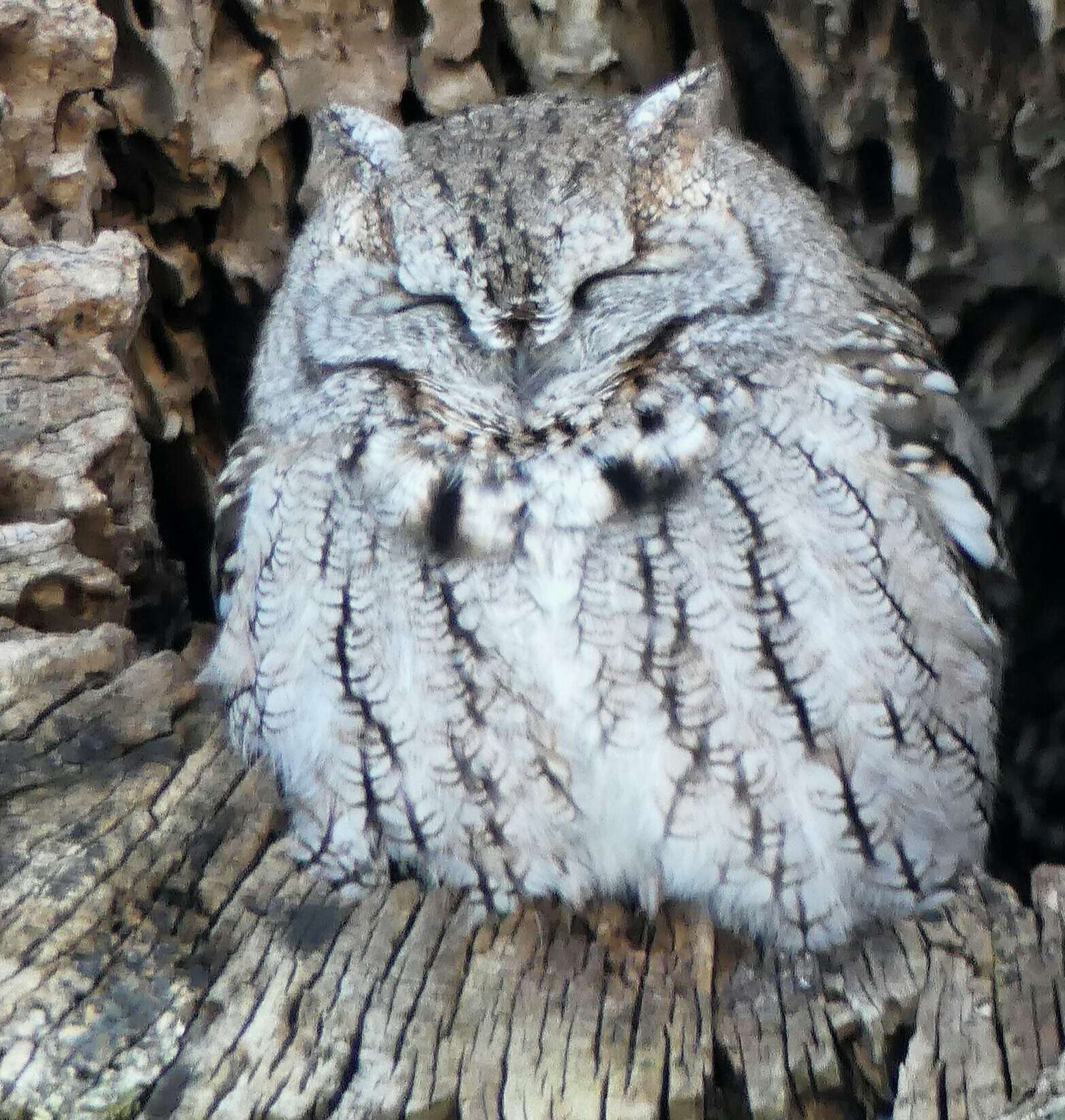


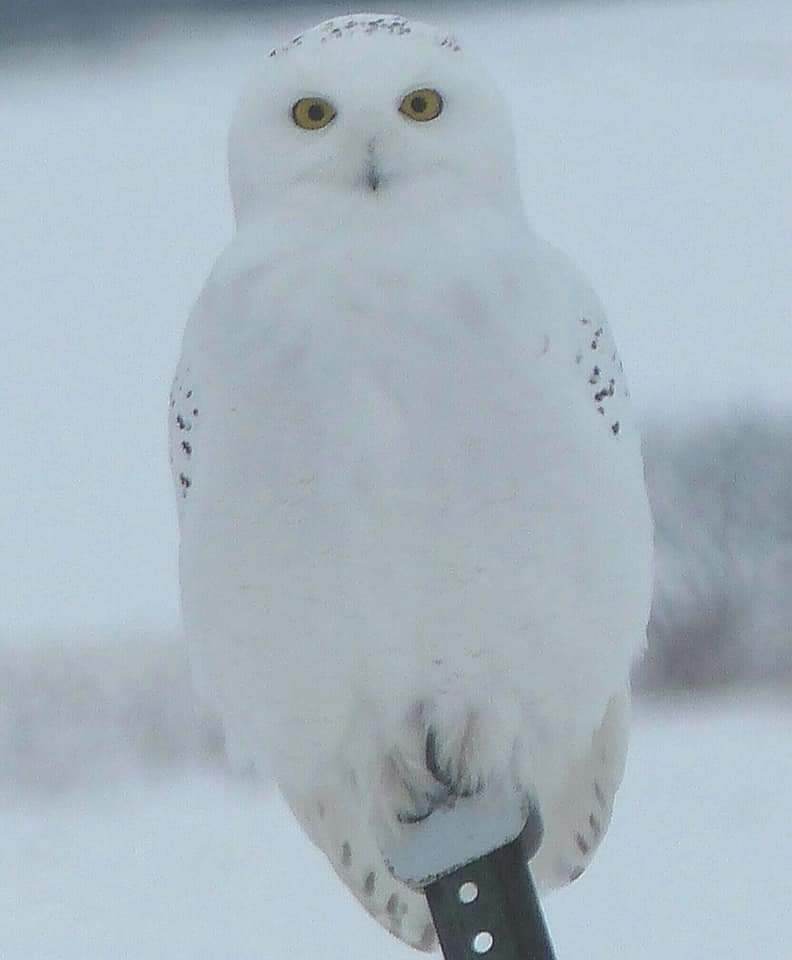
An owl’s feet are widespread and have a movable outer toe, which helps to keep wiggly prey from escaping. A Great Horned Owl (Bubo virginianus) has enormous talons, which enable it to take very large prey such as muskrats, opossums, skunks, rabbits, and even grey foxes.
The camouflaging feathers, both streaked and barred, help owls to blend with tree bark. Owls appear somewhat round in shape, but when disturbed, they can elongate their bodies, giving themselves an even more camouflaged appearance.
Owls are nocturnal, and some are also crepuscular (hunting at dawn, dusk, or on overcast days), like the Snowy or Barred Owls. Nocturnal owls roost during the day, usually in dense conifer or scrubby honey-suckle tangles, to avoid being harassed by Blue Jays and Crows. Some species use tree cavities. Others will use an owl nesting box, and some roost in barns or on rooftops.
Owls swallow prey whole and digest it for six to ten hours, depending on the size of the prey. Then, they regurgitate the undigested parts, such as the bones, hair, teeth, and nails within a pellet. The prey’s hair forms a compact pellet around the bones and other sharp parts, as this eliminates harm to the owl’s organs when it coughs up the pellet. Owl pellets found on the ground under a roost site can be collected. They are clean, odorless, and not dangerous to handle, but I prefer to wear gloves. The pellets can be pulled apart to see what the owl has eaten and, quite often, what the prey was.
The sounds made by owls are all quite unique. Some sound like “tooting,” which is the tiny Northern Saw-whet (Aegolius acadicus) vocalization, while others are quite raucous or caterwauling like those of the courting Barred Owls. Barred owls also have a memorable call that sounds like “Who, who cooks for you? Or who cooks for you all?” and it is easy to mimic. The Eastern Screech Owl (Megascops asio) makes a descending whinny which is followed by a long whistled trill. The Great Horned Owl makes the familiar ho-hoo-hoo-hoododo-hooo-hoo sound.
As with all raptors, the female owl is larger than the male. Barred and Great Horned owls will make their nests in the vacant nests of hawks and crows. A few years ago, I even photographed a nesting Great Horned Owl in Sterling Nature Center in Sterling, New York, that was nesting in a vacant Great Blue Heron nest. They were actually compatible with nesting Great Blue Herons nesting in trees on either side of the Great Horned Owl. Eastern Screech and Northern Saw-whet owls will nest in tree cavities or nesting boxes.
In past years, friends and I have traveled a few hours further north along Lake Ontario to photograph Great Gray, Boreal, and Snowy owls. Often, birding sights on the internet will mention rare sightings of Arctic owls. Major irruptions occur when there is a reduction of lemmings, which are a major food source, especially if there has been a bountiful breeding season. The migrants may arrive as early as October and even into November and December. To be able to photograph these owls is extremely exciting and well worth a moderately short drive.
 Joan Herrmann has taught and done programs for Schools, Garden Clubs, Libraries, and Nature Centers for about 38 years as a Professional Nature Photographer, Naturalist, and Outdoor Educator. After moving from the Rochester area in 1995, she began her Photography business, Essence of Nature, and became a co-owner of The Artworks in Old Forge, New York. As a docent at Munson, Williams, Proctor Arts Institute in Utica, New York, she has been educating children and adults for nineteen years.
In 2007, she began working with the Black River Outdoor Educational Program (BROEP). In 2013 and 2014, she did a week-long summer program at BROEP with Mohawk Valley Community College (MVCC).
Using her love of nature and photography, she created a Flora/Fauna outdoor educational program teaching students (ages 6 to 14) the joys of nature and creative photography skills.
Joan’s love of nature has been a lifelong study of Birds, Wildflowers, Mosses, Ferns, Trees, Amphibians, Reptiles, Grasses, Insects, Spiders, Tracks, Scat, and Galls. She has assisted in cataloging all trails used by the hiking Coaches and photographed and identified seasonal Flora.
Since October 2016, she has written a bi-monthly nature column with Adirondack Express Newspaper. In October 2019, she began a bi-monthly column with the My Little Falls newspaper. You may reach her at jmhphoto8442@gmail.com.